Posts mit dem Label Holy Tradition and Bible werden angezeigt. Alle Posts anzeigen

Mittwoch, 7. August 2019

Georgios N. Manolis, Theologian: The Participation of Nature in Worship: the Blessing of the Fruits of the Vine


According to Saint Basil the Great, nothing exists without due cause, nothing’s fortuitous, everything has some secret and unexpressed wisdom. Thus, regarding plants and their fruits, apart from their ecological importance as producers of eco-systems they’re also schools for rational souls and colleges of the knowledge of God, which train the intellect and lead it from the visible and tangible to the contemplation of things invisible.
Plants form an important element in the worship of the Orthodox Church. During the Divine Liturgy, bread and wine are used, the products of grain and grape. During the service of the Blessing of the Loaves, grain, wine and oil are blessed. Besides, in accordance with liturgical practice the fruits of the earth, such as grapes and figs, are offered and blessed once they’re ripe. Indeed, in general, every action and task linked to the earth and its cultivation is accompanied either by thanksgiving to the Creator or by supplications that the tilling and harvesting should provide plenteous amounts of fine fruit.
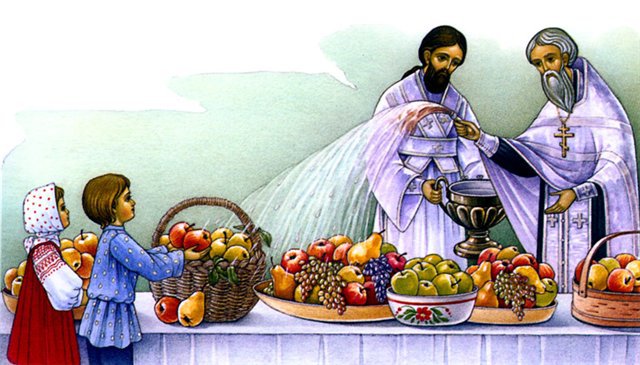
There was always a tradition in the Church that, when the bread and wine were being offered at the Eucharist, other produce and fruits of the earth could also be offered and blessed. But to preserve the tradition of offering only bread and wine at the sacrament of the Divine Eucharist the Church forbade the custom of presenting non-Eucharistic produce during the actual celebration of the Eucharist.
All that was allowed by the Church was the offering of grain and grapes, with the explanation that this offering took place at the time when fruits ripened and this was to be a blessing of the first-fruits and was by way of an expression of thanks to God for the abundance and fertility of the earth. From as early as the third century we have prayers for the first-fruits, thanksgiving to God Who had given them for the gladdening and nourishment of people. The first-fruits were brought to church as a pleasing and grateful gesture to Him.
As regards the blessing of the fruit of the vine we can see that this is an ancient tradition of the Church, for which there are two ceremonies in the Service Book of the Church of Constantinople and imperial ritual. Therefore according to ancient custom, the Church always blessed the harvest and the grapes. Indeed, a canon was introduced establishing that grain and bread be blessed before they were eaten at the beginning of the harvest.
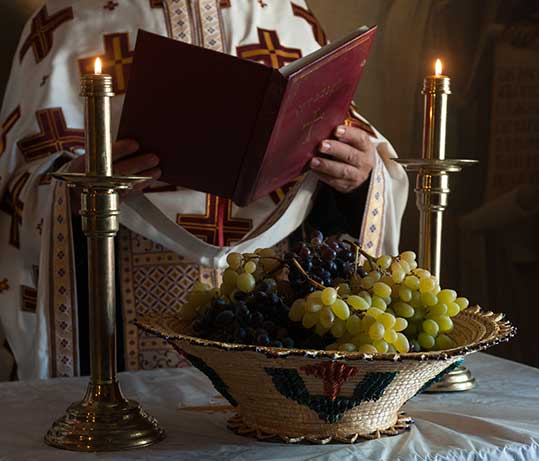
A continuation of this tradition is the blessing of the grapes at the feast of the Transfiguration of Christ the Saviour. We have a manuscript from the 10th century containing a prayer through which the Church thanks God Who was pleased to ensure that the fruit ripened, was harvested and brought gladness to people through its taste. Wine, a product of the grape, was also offered as a gift to be included in the celebration of the Divine Eucharist. There is also another, later, prayer which mentions the blessing of only the grapes, with a clear reference to the spiritual freedom guaranteed by Christ through the Eucharistic life.
It’s interesting that in certain liturgical rubrics, the blessing of the fruit of the vine takes place on the feast of Dormition of the Mother of God, after the Divine Liturgy. This was the case in Constantinople, where the Patriarch blessed the grapes on that day, in the church of Our Lady of Blachernae, in the presence of the Emperor. From other texts, it appears that the offering took pace at the feast of the Elevation of the Precious Cross. It is clear, then, that the time of the blessing of the fruit of the vine depended on the conditions prevailing in nature in each region and on the time at which they ripened.
If we wish to see the theological connection between the feast and the blessing of the fruit of the vine, our thoughts will inevitably turn to the parable of the vine, where Christ is presented as the true vine. With the blessing of the grapes, it is emphasized that people have a need of spiritual productivity and a transformational advancement towards sanctity, glorification by Grace, and communion with God. Moreover, Christ is the vine which has its roots in heaven and its branches on earth. The body- though not the root- was pruned and on the third day thereafter brought forth the fruit of the Resurrection.

It follows, then, that, with the Lord’s Transfiguration, at which His glory was revealed, the world is illumined and glorified. Consequently, creation responds with glorification and gratitude to this gift and the Church continues to bless the world and it first-fruits. This blessing of the fruits emphasizes the creation’s offering of praise and gratitude to the Creator. Besides, the grape is the fruit that gives us wine, which we offer together with bread so that they become the Body and Blood of Christ. By partaking of these, we become one in body and blood with Christ.
We, as people, received the world, blessed and sanctified, from God’s hands. Between us and our environment there was harmony and co-operation. The Fall also brought about the decay of creation, since thereafter it followed the same path as we did. After our disobedience and estrangement from God we began abusing and exploiting creation. Nature rebelled numerous times against us and opposed us, with the result that instead of functioning constructively and positively towards us, it often became negative and destructive. We feel it threatens us. The turmoil in our relations with God has brought about disruption in our relations with His creation, nature.
As Christians, however, we should not see nature as being de-sanctified but should view it as the creation and gift of God. We should feel that, in the world, we’re within the creative love of God. We Christians feel the need to respond to this love, to take elements from the material world and to offer them to God. We bring bread and wine, representative elements of the material world, in thanks to God and, after their sanctification, they’re offered back to us as the Body and Blood of Christ. In this way, we acquire a foretaste of the world as it will be transfigured in Christ in the end times.


source and thanks to: www.pemptousia.com

Montag, 22. September 2014

What is Prosforo (or Prosphoro)?

Written by Andrew Athanasiou
Many times we take for granted the bread that not only is part of communion but also the antidoron that is given after the service is over. Prosforo, the name given to the bread that is offered, is Greek meaning "the offering." We make the mistake that it is the Church's offering to us for showing up. It is actually supposed to be our offering, but unfortunately only a couple people actually take on this task of offering up the bread. We have our groups of yiayias who made bread not only for the 52 Sundays of the year, but also for numerous weekday liturgies too.
So if we wanted to begin to make the prosforo, what will we need to make it stand out over other breads? The answer is the "Seal." This seal is circle that circumscribes a cross. The cross is broken into 5 squares. The middle, top and bottom squares have a smaller cross on it with the inscription in the four corners of the square, IC XC – NI KA, which means "Jesus Christ Conquers." The seal is important for the liturgy as it gives the priest the ability to have the entire Church represented in the Body of Christ. The Lamb, the center piece is what represents our Lord and Savior, Jesus Christ, and this portion is cut out first during the Proskomide service. The Proskomide service is done before liturgy and typically during Orthros. To the right-hand side of the Lamb (to us the left side), we find a triangle for the Theotokos, the Virgin Mary.
To the left-hand side of the Lamb, we find 9 small triangles representing the 9 orders of saints–St. John the Baptist, the Prophets, the Apostles, the Holy Hierarchs, the Martyrs, the Holy Monastics, the Unmercinaries, the Ancestors of God and saint of the Church, and lastly the saint whose liturgy we celebrate (St. John Chrysostom, St. Basil, St. James and so on). Then a small triangle is cut, not from inside the sealed area, which represents the Bishop whom the liturgy is presided over, followed by crumbs for all the living and all the dead remembered. As we can see, the prosforo ends up bringing us all together (Christ, Theotokos, Saints, Bishop, Living and Dead) and we are made into the Body of Christ by the Holy Spirit.
Making the bread is not a big secret, as you can find recipes by just Googling "prosforo recipe." In our modern day we are so removed from the understanding of nature that our forefathers had. We can go to the grocery and get the flour, turn on the faucet for water, get salt out of the pantry, and we have yeast ready to go, in individual sized pouches nonetheless. What we fail to understand is that prosforo was a real offering of time and concentration and sacrifice. The grain needed planted and tended to, then picked and crushed, the water needed to be carried from the well, the yeast needed to be naturally cultivated, and the wood needed cut to be able to "bake" the prosforo. We take God's creation, mold it into our own "creation," different than it was before, and give it to God as an offering, and he in turn gives it back to us as the Body of Christ. We are called the Priests of Creation and we are the connection between the Creation and the Creator.

Source: greekboston.com

Mittwoch, 6. August 2014

Fotis Kondoglou- Traditional and ‘Modern’ Art

Text written somwhere in the 1950s…

Most people value art that depicts what it wants to portray in a natural way. But this is a mechanical task that shows people what they’re looking at, without changing it in any way, as authors would if they just recorded the words coming out of somebody’s mouth, like a phonograph. That might require some skill that could be learned, but it’s not art.
Art is taking what you see as a starting-point, then changing it within yourself in your own way and making a work that’ll have some real substance, without being a faithful copy. In any case, depicting anything whatever exactly as it is in nature would be a pointless task, since all things are either eternally before us or are constantly recurring features- people, animals, trees, mountains, clouds, the dawn, the sunset, noon, the sea, boats and anything else you can think of. So what need is there for you to do the same thing on canvas or wood, especially when you’ll never achieve the vibrancy that the real things enjoy? […]
To make my meaning clearer, let me give you an example. The Assyrians knew all about lions and didn’t kill them when they hunted them but captured them alive and put them on display in cages.  Since they loved them and admired them for their bravery, they wanted to depict them in their art, so they engraved them on rocks and palaces. And although they were among the most ancient peoples to apply themselves to art and although their art isn’t naturalistic, in the way that most people today would recognize, nevertheless, no artist, painter or sculptor has ever portrayed the lion with such vibrancy and truth.
And if you put the lions that these Assyrians made next to those that some modern artists have produced, such as the works of the French sculptor Barye, who was an animalier, or the lion recumbent in a cave in Nafplio, and another etched onto the same rock face of the cave as another by some Bavarian artist, you’ll see how much vibrancy and inexplicable truth the older ones have compared to the newer, even though they’ve been produced with great simplicity, whereas the modern ones have been done with great knowledge and attention to the smallest detail, down to the hairs of their whiskers and the skin covering their claws.
The latter have been made by people who studied the animals alive in zoos or dead in a dissecting room. Yet despite this, the more faithfully and carefully they imitated them the less vibrancy and truth there is in their works. Because all things, be they animals, trees, mountains, or the sea, are shrouded in mystery which people don’t see if they only look at the outer form of each of them. This mystery is their soul and if you capture it and can record it, there’s no need for you to struggle to imitate the external details, which don’t contribute at all towards making your work real.
The Assyrian who worked on the rock with an awl had a simple soul, his eye saw simply and he captured this mystery, this essence of the lion, without becoming confused and losing it or getting all tied up in the fur and minor details, thinking that this would be closer to the truth, whereas in fact it takes you further away from it. And in this way, he was able to encompass within one lion the vibrancy and truth of all lions and thus reinforced its character. The others, though, weakened it because they lacked that simple and vital spark that finds the essence in all things. Instead they laboured to embellish their works with a whole host of pointless things. This is why the one lion is a work of art and the other a dead copy of nature, like those you see in zoology books.
The same’s true of everything else. Flowers, for instance which some real artists have been able to depict simply, but with great sensitivity and you can see how they’ve managed to capture their elegance and their scent.
So naturalist art is the most inferior kind and the only aim of a painter who paints naturally is atrompe l’oeil effect, which makes them some kind of wonder-worker. But this belittles art. Many modern painters, however, in their efforts to escape this narrow and sterile fidelity to nature went to the opposite extreme and made works that are arbitrary, that have no inspiration, no power to move, nothing at all except that they’re not naturalistic. It seems as if modern artists are always experimenting, like scientists, without anything firm to go on.
This basis is what we call tradition. Tradition supports the artist through various rules, and while though this doesn’t restrict the boundaries of a person’s art, it does make the work commendable. Half-baked artists don’t want tradition because, supposedly, they then lose their freedom, by which they mean that they can do whatever they want in a slapdash manner. But with all this freedom that they talk about, they don’t do anything except make everyday things that you get tired of looking at. Tradition, on the other hand, reinforces the personal ability of the artist, as long as it’s taken as a basis on which their own things can be produced.
You might think of tradition as the setting of the loom, which is the same for whatever weave you’re working on, whereas the pattern is the art of weaver, based on tradition, and is what makes the real work. In this way, art acquires a significance and a truth that makes it like a natural phenomenon, whereas art that’s detached and wants to work without rules produces artificial pieces, like flowers and plants made of paper, which haven’t got any roots.
There are lots of clueless people who have the notion, as we’ve said, that the sole aim of art is to make natural things, and who don’t demand any more from the artist. This is why, in every age, clueless people such as these think that naturalistic art is the most ‘modern’. This is what churchwardens and priests ask us for: natural saints, because they think they’re more ‘modern’. How do you expect the unfortunate people to know that the Byzantine is the more ‘modern’ and that the naturalistic is the older? They were painting in a naturalist manner before the birth of Christ, as is shown by the artwork in Pompeii, whereas the Byzantine works appeared later.
The most profound art is religious, and the most profound of all religious art is Byzantine, because it’s spiritual, because it’s rooted in the truth, in the Gospels. You don’t have to have studied in order to feel this art. All it needs is a devout and pure heart because you appreciate it as a feeling rather than with your mind, as is the case with naturalistic art, which you look at to see if it looks natural, if the anatomy and perspective and so on are correct, as if these things contributed towards making it a real work of art.
This is another sign that people today have degenerated, are wallowing in material things and are incapable of feeling the spiritual. Yet our forebears, who were illiterate, understood and venerated these stern and spiritual works of art that we see in old monasteries and churches, painted on the walls or the planks or woven onto cloth. They didn’t ask why they weren’t as natural as photographs, the way their degenerate descendants do. The old folk appreciated the artists who created these works.
It really is a most wonderful thing how, with faith in Christ, even the most untutored, rough people can become spiritual in all things. What progress have we made, who are supposed to be well-read, mightily intelligent and academic when we put into our churches those dreadful green and red rub-ons, invested with some sort of tin shirting and with rays of bits of metal around the saints’ heads! And just to make everything blend in nicely together, we also put tinny ‘modern’ music, that is bland voices, without any substance, that are put out to air from the mouths of balladeers who can’t sing. Even a people such as ours will sink to such depths if it casts off its tradition in a vain attempt to show it’s not rustic and backward, but terribly civilized. Like a sailor who goes mad in the middle of the ocean, throws away his compass and doesn’t know where he’s headed.
You can’t even laugh at this comical sight, because you see the depths your own people have plunged to and it hurts. Very much to blame for this are those charlatans who’ve deceived ordinary people with their adverts, their coloured flares and theories full of stupidity and illiteracy.
We’re only a few people labouring to bring people to more or less the true path, showing them, as best we can the spiritual morass into which they’ve fallen and are sinking deeper by the day. And they call it progress and civilization.
Glory to God, our struggle is starting to bear good fruit. Greeks are beginning to come to their senses, to stir from their drugged state, to want to become real and to regain their former warmth and sympathetic air. They’re beginning to despise those cold fish that call themselves ‘modern’. When you see them, you wonder how our serious and brave nation has ended up with so cold, bland and effeminate.

source: pemptousia.gr

Mittwoch, 2. April 2014

The Parable of the Pearl - Fr. Victor Potapov


The parable of the pearl, which we encounter in the thirteenth chapter of the Gospel according to Matthew, in the profundity of its meaning is very much like the previous parable of the treasure hid in the field.
Again, the kingdom of heaven is like unto a merchant man, seeking goodly pearls: who, when he had found one pearl of great price, went and sold all that he had, and bought it (Matthew 13:45-46).
In antiquity, pearls where valued very much, perhaps even more than in our time. Christ's contemporaries were ready to pay a great deal for a good pearl, and therefore they understood perfectly well the words of Jesus, that in order to acquire the Kingdom of Heaven it is necessary to give up everything for the sake of acquiring that which Christ offered to them.
In the parable, the pearl is the symbol of the Gospel preaching. The merchants are men who are seeking knowledge. In the world there are many pearls, i.e., many forms of knowledge, but only one knowledge is genuinely precious ­ faith in Jesus Christ. It is appropriate to compare men who are carefully acquiring the knowledge of Christ and are gradually apprehending the truths of the evangelical life that leads to the blessedness of the Kingdom of Heaven, with a merchant who seeks pearls, and, who having sold many small ones, buys with the money gained from them the one that is unique and precious. "He that possesses the pearl knows that he is rich," says John Chrysostom, "but others often do not know that they have a pearl in their hands, because the pearl is not big: the same can also be said about the truth. Those possessing it know that they are rich, but unbelievers, not understanding the value of this treasure, do not know of our wealth."

If in the parable of the treasure hid in the field the discourse was about the sudden finding of God's truth, then the parable of the pearl tells about the finding of this truth after a long search. Such was the path of Prince Vladimir, the Enlightener of the Russian people, who in the Church's troparion is directly called "the merchant who sought the goodly pearl". He sought the truth faith and found it. As a Christian, Prince Vladimir was able to value the Gospel as the most precious thing that a man can have and Christ as the Only One Whom it is possible to submit to until the end and to serve.
Saint Justin the Philosopher can serve as an example of one who sought the truth and found it only in the teaching of Christ. In his work "Dialogue with Tripho, a Jew", he writes that while still a pagan he studied all the philosophical systems of that time (Second Century) and was especially enamored of Plato's teaching. But all his knowledge did not give him an answer to the questions that interested him about God, about the soul, its immortality, etc., until an elder (Saint Polycarp, according to tradition) told him about Jesus Christ and the prophets who foretold His coming. Having studied the prophecies and the Gospel itself, Saint Justin found the one true and beneficial philosophy ­ the pearl ­ only in them.
In the lives of the holy God pleasers it is possible to find not a few examples of how the words of Sacred Scripture, sinking down into the souls of men who were unbelievers but who were seeking the pearl, put them on the track of this treasure ­ to faith in Christ and to life in Him.
So let each of also also seek this one pearl which is the most precious ­ the faith of the Gospel. Search the scriptures …. says the Lord …they are they which testify of me (John 5:38). We shall find the precious pearl of Christ by attentive and prayerful study of the word of God, for it brings us to the narrow way of finding that which the Lord spoke of to Martha, the sister of Lazarus who was dead for four days ­ the one thing… needful (Luke 10:42).

In the book "Way of the Ascetics", by Tito Colliander, we encounter a chapter under the title "On the Pearl of Great Price". The author writes of the signs of finding the precious pearl: 
"…the deeper you pressed into your own heart, the farther and higher you climbed out of yourself. The outward conditions of your life are the same: you wash dishes and care for the children, you go to work, draw your salary and pay your taxes. You do everything pertaining to your external life as a person in a society, since there is no chance of leaving it. But you have resigned yourself. You have given away one thing in order to receive another.
"…and if I have Thee, what more do I ask on earth? Nothing, answers St. John Climacus, but ceaselessly praying, silently to cling to Thee. Some are enslaved by riches, others by honour, still others by acquiring possessions; my only desire is to cling to God.
"Prayer, with all it contains of self renunciation, has become your real life, which you keep up as though only for the sake of prayer. Walking with God (Genesis 6:9) is from now on the only thing that has real value for you, and it includes all heavenly and earthly events. For him who bears Christ within himself there is neither death nor illness or any earthly clamour; he has already stepped into eternal life, and that embraces everything.

"Night and day the heavenly seed sprouts in your heart and grows, you know not how. The earth produces of itself, your heart's soil, first the blade, then the ear, then the full grain in the ear (Mark 4:27-28).
"The saints speak of something they call the inextinguishable light. It is a light not of the eye but of the heart that never ceases to walk in purity and clearness. It swiftly leaves the darkness behind, and constantly strives towards the day's height. Its constant quality is to be continually purified. This is the light of eternity that can never go out, and that shines through the veil of time and matter. But the saints never say that this light is given to them, but that it is given only to those who have purified their hearts in love for the Lord on the narrow way which they have freely chosen."

It is worth renouncing everything for the sake of obtaining that which Christ offers us ­ the pear of His teaching and the life of blessedness in Him.


http://www.stjohndc.org/

Samstag, 29. März 2014

Holy Tradition and the Bible - by Elder Sophrony and St. Siluan the Athonite


Sacred Tradition, as the eternal and immutable dwelling of the Holy Spirit in the Church, lies at the very root of her being, and so encompasses her life that even the very Scriptures come to be but one of its forms. Thus, were the Church to be deprived of Tradition she would cease to be what she is, for the ministry of the Spirit of the New Testament is the ministry of the Spirit ‘written not with ink, but with the Spirit of the living God: not in tables of stones, but in the fleshly tables of the heart’. (cf. 1 Cor. 3:18-19).  
Suppose that for some reason the Church were to be bereft of all her books, of the Old and new Testaments, the works of the holy Fathers, of all service books – what would happen? Sacred Tradition would restore the Scriptures, not word for word, perhaps – the verbal form might be different – but in essence the new Scriptures would be the expression of that same ‘faith which was once delivered unto the saints’ (Jude 3). They would be the expression of the one and only Holy Spirit continuously active in the Church, her foundation and her very substance.  The Scriptures are not more profound, not more important than Holy Tradition but, as said above, they are one of its forms — the most precious form, both because they are preserved and convenient to make use of. But removed from the stream of Sacred Tradition, the Scriptures cannot be rightly understood through any scientific research.  

If the Apostle Paul had the ‘mind of Christ’, how much more does this apply to the whole body of the Church of which St. Paul is one member! And if the writings of St. Paul and the other Apostles are Holy Scripture, then new Scriptures of the Church, written supposedly after the loss of the old books, would in their turn become Holy Scripture for according to the Lord’s promise God, the Holy Trinity, will be in the Church even unto the end of the world.  Men are wrong when they set aside Sacred Tradition and go, as they think, to its source — to the Holy Scriptures. The Church has her origins, not in the Scriptures but in Sacred Tradition. The Church did not possess the New Testament during the first decades of her history. She lived then by Tradition only — the Tradition St. Paul calls upon the faithful to hold (cf. 2 Thess. 2:15).  

It is a well-known fact that all heresiarchs have always based themselves on the Holy Scriptures, only their interpretations differing. The Apostle Peter spoke of this perversion of the meaning of the Scriptures when they are construed personally, by the individual reader (cf. 2 Pet. 3:16).  Individual members of the Church — not excluding her finest sons and teachers — do not achieve the whole fulness of the gifts of the Holy Spirit, and so their teachings and writings are marred by one or another imperfection — sometimes even error — whereas as a whole the Church’s schooling, possessed of the gifts and knowledge, remains true for all time.
 By Elder Sophrony and St. Siluan the Athonite

Source: St. Silouan the Athonite, Chap.5: The Staretz’ Doctrinal Teaching