Posts mit dem Label Saints werden angezeigt. Alle Posts anzeigen
Posts mit dem Label Saints werden angezeigt. Alle Posts anzeigen
Sonntag, 8. Dezember 2019
Elder Ephraim of Arizona reposed in the Lord
December 7th 2019, the much-beloved Elder Ephraim of Arizona reposed
in the Lord after being ill for many years. According to reports,
Elder Ephraim was aware of his impending death some days before, and
despite this he would still daily go out and give his blessing to the
people. His personal doctor told him to not go out Saturday evening,
the day of his repose, to bless the people. Elder Ephraim was lucid
on the day of his repose and partook of the Immaculate Mysteries. Then
at 9:00pm (Mountain Standard Time), as he was upright occupied with
something, he suddenly tilted slightly to the side and died. Nurses
found him practically upright, having delivered his spirit to the
Lord.
Elder Ephraim, also known as Ioannis Moraitis, was born on June 24, 1928, in Volos, Greece. He spent his childhood in poverty helping his father with his work, but he always followed the example of his mother (who later became a nun and bore the name “Theophano”).
 At the age of 14, he decided to follow a monastic path, but his
spiritual father did not give him the blessing to go to Mount Athos
until he was 19 years old. Upon his arrival at Mount Athos on September
26, 1947, he went straight to Elder Joseph the Hesychast in the
Monastery of Timios Prodromos (Saint John the Forerunner), who accepted
him into his brotherhood. Nine months later, in 1948, he received the
name “Ephraim”.
At the age of 14, he decided to follow a monastic path, but his
spiritual father did not give him the blessing to go to Mount Athos
until he was 19 years old. Upon his arrival at Mount Athos on September
26, 1947, he went straight to Elder Joseph the Hesychast in the
Monastery of Timios Prodromos (Saint John the Forerunner), who accepted
him into his brotherhood. Nine months later, in 1948, he received the
name “Ephraim”.
In 1973, the brotherhood moved to the Holy Monastery of Philotheou where Elder Ephraim became abbot. Thanks to his good reputation, the monastic brotherhood grew rapidly.
In 1979, he went to Canada due to health issues. Along with his medical examinations, he was preaching the Greek population and hearing their confessions. Then, he wanted to establish a monastery in America, so that the Greek population would have their own spiritual place.
He established 19 monasteries in North America, 17 in the US and 2 in Canada, both for men and women, which are subject to the Greek Orthodox Archdioceses of America and Canada. Elder Ephraim lived in St. Anthony’s Monastery in Arizona, not too far away from Phoenix and the town of Florence.
sources and gratitude to: orthochristian.com, orthodoxtimes.com
Elder Ephraim, also known as Ioannis Moraitis, was born on June 24, 1928, in Volos, Greece. He spent his childhood in poverty helping his father with his work, but he always followed the example of his mother (who later became a nun and bore the name “Theophano”).

In 1973, the brotherhood moved to the Holy Monastery of Philotheou where Elder Ephraim became abbot. Thanks to his good reputation, the monastic brotherhood grew rapidly.
In 1979, he went to Canada due to health issues. Along with his medical examinations, he was preaching the Greek population and hearing their confessions. Then, he wanted to establish a monastery in America, so that the Greek population would have their own spiritual place.
He established 19 monasteries in North America, 17 in the US and 2 in Canada, both for men and women, which are subject to the Greek Orthodox Archdioceses of America and Canada. Elder Ephraim lived in St. Anthony’s Monastery in Arizona, not too far away from Phoenix and the town of Florence.
sources and gratitude to: orthochristian.com, orthodoxtimes.com

Donnerstag, 29. August 2019
Mittwoch, 17. Juli 2019
The Holy Victorious Martyr Marina
The Holy Victorious Martyr Marina – 17 July

Saint Marina was from a village in
Pisidia, the daughter and only child of a certain Aidesios, a pagan
priest, and lived in the reign of Emperor Claudius II. When she was
twelve, her mother died and she was given into the charge of another
woman and she asked of God to be granted the faith of the Christians,
which was being taught in the village by some of them at that time. When
she became fifteen, in 270, she had a desire to die as a martyr for the
love of Christ. With one occasion, the governor Olymbrius sent people
to arrest her and cast her into prison. After several days had passed,
she was fetched from the prison and appeared in court before him. But
when he saw her, he was astonished at her beauty.
He asked her name and her circumstances
and she replied: “I’m called Marina; I was born and bred in Pisidia; and
I call upon the name of my Lord, Jesus Christ”. Since she wouldn’t
consent to deny Christ, the governor ordered that she be stretched out
on the ground and beaten mercilessly with rods.
She was brought to a second examination
and, because of her persistence in the Christian faith, was burned with
lighted candles and placed head-down in a vat full of water. Since she
remainesd unharmed, she attracted many unbelievers to faith in Christ
who were beheaded and won crowns for their efforts. The governor then
became angry and struck off the saint’s head. Her synaxis is held in the
church of Saint Minas.
(Saint Nikodimos, Συναξαριστής τ. ΣΤ΄-Ιούλιος, Αύγουστος, New Skete, Holy Mountain, pp. 80-2)
https://pemptousia.com
Finnish Church celebrates canonization of St. John of Sonkajanranta
Sonkajanranta, Finland, July 15, 2019

On November 29,
the Holy Synod of the Patriarchate of Constantinople announced its
decision to glorify among the saints the holy Martyr and
Confessor John of Sonkajanranta (1884-1918) at the proposal of the
Finnish Orthodox Church, an autonomous body within the
Patriarchate.
Johannes Vasilinpoika Karhapää was an Orthodox missionary who was
killed by the White Guards during the Finnish civil war. Schema-Abbot
John of Valaam was canonized on the same day, which was liturgically
celebrated on June 1.
The liturgical proclamation of this glorification was celebrated on
Saturday at the Church of the Holy Prophetess of God Anna in
Sonkajanranta in southeastern Finland by His Eminence Archbishop Leo
of Helsinki and All Finland, with the concelebration of several other
hierarchs from the Finnish Church, reports the Finnish Church.
A large number of clergy and faithful from throughout Finland,
including relatives of the newly-canonized saint, were present for the
festal Divine Liturgy. The small church was filled to overflowing,
with many faithful watching a broadcast of the service in the
courtyard.
Abp. Leo
addressed the gathered faithful with a sermon about the labors of the
holy Martyr John and Protodeacon Juha Pessie read out the life of the
new saint. Following the Divine Liturgy, a solemn procession was held
with the icon of the saint to a memorial cross erected in his honor
in the 1980s, where a moleben was served.
Following the moleben to St. John, all the guests were treated to a
festive lunch. The official celebrations then finished with the
chanting of an akathist to St. John at the memorial cross. All present
were blessed with the gift of a memorial icon of St. John.
St. John was
born in 1884 in the Sonkajanranta village in Ilomantsi. He married and
had two children, and was married a second time after his wife died
in 1910.
He developed a strong and active Orthodox faith in his childhood. In
response to fervent Lutheran missionary work, St. John founded an
Orthodox school and association as a subdivision of the Sts. Sergius
and Herman Brotherhood that actively countered the Protestant
propaganda.
St. John also worked as a traveling catechist in Ilomantsi, and in
1914, he was appointed as a teacher of religion for the entire Kuopio
Province. His great activity also earned him a number of enemies who
called him a henchman of the tsarist regime and even accused him of
being a spy.
In 1915, the Church of St. Anna, where the glorification of St.
John was celebrated, was built for the school he had founded. St. John
received a number of distinctions for his zealous teaching and
missionary work, though he was also hated as a propagator of the
“Russian faith.” Accusations against him intensified following the
Russian revolution in 1917 and he was also accused of being a
Bolshevik. St. John never responded to any of the heinous accusations.
Eventually he was slandered among the Orthodox faithful as well, and
it was demanded that he be removed from his Church positions. Having
lost the support of the local archbishop as well, St. John was seen as
a criminal in the turmoil of the Finnish civil war.
St. John and his brother were arrested in March 1918 after a small
icon was found in his pocket. They were locked up in the basement of
the Joensuu town hall with other prisoners. He was later shot by a
group of rowdy White Guards. The exact date of his execution is
unclear.
His wife was able to obtain his body only months later, and he was
buried in Ilomantsi with a large group of Orthodox and Lutherans
attending.
***
Troparion, Tone 2
Thy martyr John, O Lord / rejoices crowned as a saint in Heaven /
as the first-begotten of our people, / for spurred on by Thee, he
served for the good of the true faith even unto death. // By his
prayers have mercy upon our souls.
Troparion, Tone 5
The faithful bow to thee today, John, / Instructor of the word of
God, / for difficult was thy path, of fervent faith and Divine
inspiration, / and as an innocent victim brutally murdered / thou dost
abide in the joy of the Heavenly Kingdom. // Therefore we honor thee
as a martyr.
Source and thanks to: http://orthochristian.com
Samstag, 30. März 2019
Donnerstag, 28. März 2019
St John of the Ladder
To Western eyes, the monk, increasingly,
is a figure of yesterday, and the commonest images of him are of the
kind to make easy the patronizing smile, the confidently dismissive
gesture, or that special tolerance extended to the dotty and the
eccentric. Around Friar Tuck, with his cheerful obesity, and Brother
Francis, harming no-one as he talks to birds and animals, vaguer ghosts
manage to cluster, gaunt, cowled, faintly sinister, eyes averted or
looking heaven-wards, a skull clutched in a wasted hand, with gloom
arising, and laughter dead.
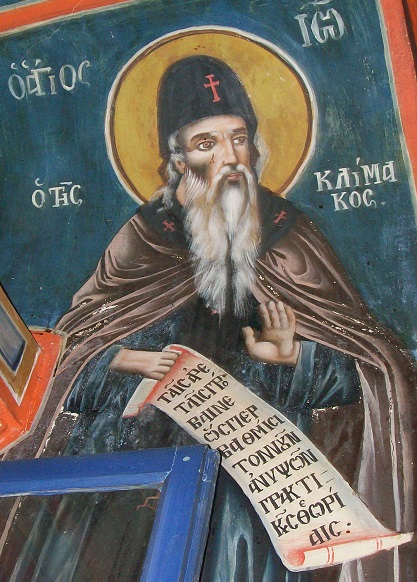
Somewhere in the background there are
bells and hymns, and psalms chanted well after midnight; and, as if to
confirm that these are only the leftovers of a past surely and
mercifully gone, there is the dumb presence of all those European
monasteries visited for ten scheduled minutes during a guided tour, or
else sought out on warmer evenings by courting couples.
But for Christians, that is, for someone
who believes that there is a God, that God has manifested Himself in
historical surroundings in the person of Christ, and that insights and
obligations are thereby held up to everybody, the monk cannot easily be
shrugged off…
A linguistic usage, so long
employed by Christians that it has the look of being quite simply
“natural” surrounds the individual monk with a wall of venerable words, a
wall more solid and endurable than any that may set the boundaries of
the area where he actually lives. For the talk is of “withdrawal” from
“the world”, of “renunciation”, of a “monastic life” in contrast with
the way other people happen to live, of being “apart from”, “away from”
the rest of mankind, of pursuing a “dedicated” and “consecrated” path.
And this language, with its emphasis on the difference between the monk
and all others, very quickly begins to generate something more than a
set of descriptions. It begins to imply a value system, a yardstick of
achievement and worth until at last, and not surprisingly, there grows
the irresistible urge to speak of a “higher”, “fuller”, and “more
perfect” way of life…
Given those circumstances, it is
reasonable to wonder how a Christian may now cope with the vast
literature to which he is heir. It is also reasonable to anticipate that
he will approach it with something less than automatic deference. And
amid all the competing voices, his capacity to deploy a commitment and a
sustained interest may well diminish as he strives to assemble for
himself and for his friends criteria of evaluation that make some kind
of accepted sense. How, for instance, is he to approach a work like The
Ladder of Divine Ascent by John Climacus?
The setting at least can be
readily established. The Ladder is a product of that great surge of
monasticism which appeared first in Egypt during the third century,
spread rapidly through all of Christendom, and eventually reached the
West by way of the mediating zeal of figures such as John Casssian. The
general history of this most influential development in the life of the
early Church is well known, even if details and certain interpretations
continue to preoccupy scholars, and there is no need to attempt here a
sketch of what has been so well described by others…
That many of the first monks had
glimpsed a connection between the experience of hardship and an enhanced
spirituality is evident in the writings of the early Church. And in the
neighborhood of that perceived connection were other sources of the
resolve to enter on a monastic life. There was, for instance, the belief
that, given the right conditions and preparation, a man may even in
this life work his passage upward into the actual presence of God; and
there, if God so chooses, he can receive a direct and intimate knowledge
of the Divine Being. Such knowledge is not the automatic or the
guaranteed conclusion of a process.
It is not like the logical outcome of a
faultlessly constructed argument. There is no assurance that a man will
come to it at the end of a long journey. But to many it was a prize and a
prospect so glittering that all else looked puny by comparison; and,
besides, there were tales told of some who, so it seemed, had actually
been granted that supreme gift of a rendezvous…
There is now in the consciousness
of the West a terminology and set of value judgments centered on the
person. From the era of the Renaissance and the Reformation up to the
present time, there has been a steady progress in the insistence on the
reality and the inherent worth of the individual. Some philosophers, of
course, would argue that man the word-spinner has in this merely
demonstrated once again his capacity to sublimate reality and has only
succeeded in hiding from himself that he is no more – and no less- than a
very complex organism.
But this is not a widely shared view.
Instead, there is much talk of human rights, of one man’s being as good
as another, of the right of the poor to share in the goods of the world,
of one-man-one-vote. What all this has done to a belief in God is a
theme of major import. However, on a more restricted plane, a difficulty
for anyone today reading The Ladder of Divine Ascent or similar texts
is that in these a somewhat different view of the person is at work. If
modern Christianity has invested heavily in the notion of the value of
the individual person, it has been at the cost of a seeming
incompatibility with much that was felt and believed in the early
Church.
Mittwoch, 27. März 2019
Saint Maximus the Greek, the tireless preacher of Patristic Tradition

During its long historical past the Great Holy Vatopedi Monastery has proved to have played a double role in its spiritual activities. It pursued both a hesychastic life and freedom from worldly care, that are the basics to achieve theosis, and it also sent its saintly children out on missionary work to be the living examples of the Orthodox Athonian Tradition and thus support the people of God, something not alien in the life of the Church through the centuries. We can here say that it excelled in this role so much that the lot of missionary work fell on it not only within Greece but out of it too.
St. Maxim Vatopedinos, known as “St.
Maxim the Greek”, was one of the most erudite monks , who stood out as a
theologian, philosopher and poet during the first half of the 16th century, and became known as “the illuminator of the Russian people.”
He was born in Arta, a town in the
northwest of Greece in 1470. He came from a well-to-do, illustrious and
God-fearing family, and his name was Michael Trivolis. His parents sent
him to school in Arta and then to Corfu. At the age of twenty he went to
Italy, where he studied at the universities of Venice, Padua, Ferrara,
Florence and Milan for fifteen years. E. Golubinski, one of the most
reputable of St. Maxim’ biographers, states that if he had decided to
stay on in Italy, he would have become one of the most eminent
professors at any one of those universities at the time.
But St. Maxim began to search in earnest
for the authentic way of Christian life, because he realized man’s
poverty without God’s grace, after having a taste of the Renaissance
Humanism in Italy where it was at its peak just then. He saw that
moralism had turned people towards the irrational passions of hypocrisy,
greed, inhumanity and vice. He happened to hear about the monastic
community of Mt. Athos and, fervently wishing to reach the highest human
achievement that of theosis, after having a first hand taste of the
futility of all kinds of human glory and wisdom, he decided to become a
monk and dedicate himself to God. So he went to Mt. Athos, this renowned
cradle of Eastern Orthodox Tradition, and finally settled at the Great
Holy Vatopedi Monastery.
An Anchorite in Mt. Athos
At the Vatopedi Monastery he lived a
life of ascesis for about 10 years. He practised the fundamental virtues
of obedience and abstinence, which helped him overcome all human
passions actually, because he cut off his own will, desire, greed and
pride. His unquenchable desire to acquire virtues and his admirable
application of them, made him reach the high virtues of humility,
poverty and love. These virtues turned him into a man of constant
self-sacrifice towards his fellow ascetics and fellow men. At the same
time, by practising constant prayer, he merged his soul with God and
turned it into a temple of the Holy Spirit.
The extensive library of the Monastery
offered spiritual food to the saint. He never stopped taking delight in
its books. His studying of the rare manuscripts of the library, helped
him harvest the wisdom of the preceding hosii of Orthodoxy, while the
example of the other scholarly fathers of the monastery was the
signal-light and guide of his angelic monastic life.
The other fathers of the brotherhood
soon became aware of his cultivated and rich in virtues and charismata
soul, and they entrusted him with some necessary jobs outside the
monastery walls. This gave the saint the chance to help our orthodox
people who were suffering because of their illiteracy, the Turkish yoke
and the heresies from the West.
In 1515, the Tsar Vasilius Ivanovitz,
asked both the Ecumenical Patriarchate and the “Protos” of Mt. Athos to
send him an experienced scholar and virtuous monk to translate various
ecclesiastic texts into the Russian language and also to emend the
incorrect translations and copies of the Holy Bible and the Patristic
texts in existence. Monk Savvas from Vatopedi was initially chosen, but
he declined because of his advanced years; then the lot fell to the
eminent monk Maxim.
His going to Russia
Maxim left Mt. Athos in 1516. The Moscow
Metropolitan Valaam and the Tsar Vasilius Ivanovitz welcomed the
Athonian monk and his followers on behalf of the Russian people.
Unfortunately, during that time the Russian nation was suffering because
of various newfangled ideas that had also found their way into the
orthodox ecclesiastic books maybe not inadvertently. Maxim worked hard
and wrote many books of spiritual content, translations, emendations and
hermeneutic works. His upright and virtuous behaviour soon attracted
the Tsar, the Metropolitan and the simple people together with some
prominent men that saw in him the wise monk, who- with God’s help- could
solve, by his wise teachings and advice, the many and various problems
of people from all walks of life. In this way he began his advisory work
mainly towards the Russian ruler and the Metropolitan, who governed the
state and the church.
It is worth mentioning here that St.
Maxim Vatopedinos was the first to introduce the Russians to the ancient
Greek philosophy and literature due to his long scientific studies in
Italy. He was also the first to introduce printing in Russia, having
close ties with the famous scholar and printer Aldus Manutius. In
general, the illuminator and isapostle Maximus worked wisely in various
ways, taking care to educate as many people as possible, who in turn
continued the colossal work of the Orthodox enlightenment of the Russian
people for the glory and joy of the Church God. All these cultural
activities of St. Maxim underline the various and beneficial efforts of
the Saint, that prove him to be not only a missionary but also a
civilization worker for the Russian people, at a time when Russia was in
a state of illiteracy and ignorance.
St. Maxim missionary work lasted for
eight years. His confessional work, though, resulted in a heavy cross he
had to bear, or, to put it in other words, the Devil, the enemy of all
truth tried to destroy Maxim’s work but he failed, because the grain of
seed ‘ fell into the good ground, and grew, and brought forth fruit a
hundredfold’ ( Luk. 8. 8)
Conflict with the state and church authorities
We have to make it quite clear here that
because of the many wrongdoings of certain political and church people-
which sometimes happened because of ignorance- the Athonite Father had
to protest and castigate some people, based on the teachings of the
Bible and according to the authority bestowed upon him by the Russian
Church and the Emperor. Unfortunately, this, instead of helping
ameliorate things, it bought him the enmity of the people concerned.
Among them we find the Tsar himself and the new Metropolitan of Russia
Daniel, who did not understand the real concern of the saint for the
salvation and the adherence to the right dogma of the Russian Church.
Dienstag, 26. März 2019
Mittwoch, 20. März 2019
Saint Alexios, the Man of God

Varied are the paths upon which God leads
those who desire to please Him and fulfill His law. There lived in Rome
at the time of Emperor Honorius a high-ranking dignitary, Euphemianus,
who was highly respected and extremely wealthy. He and his wife,
Aglaida, led a God-pleasing life. Even though he was wealthy,
Euphemianus sat at the table only once a day, after the setting of the
sun. He had an only son, Alexios, who was compelled to marry when he
became an adult. But, on the night of the wedding, Alexios left not only
his wife but also the home of his father. He boarded a boat and arrived
at the city of Edessa in Mesopotamia, where there was the wondrous
image of our Lord, sent there by our Lord Himself to King Abgar. Having
venerated this image, Alexios clothed himself in the garb of a beggar.
As such, he lived in the city for seventeen years, continually praying
to God in the vestibule of the Church of the Theotokos. When it became
known that he was a holy man, he became frightened of the praise of men,
departed Edessa, boarded a boat, and traveled to Laodicea. According to
God’s providence, the boat was carried off-course and sailed all the
way to Rome. Considering this to be the hand of God, Alexios decided to
go to the house of his father and there, unknown, continue his life of
self-denial. His father did not recognize him but of charity allowed him
to live in his courtyard in a hut. Alexios remained there for seventeen
years, living only on bread and water. Mistreated by the servants in
various ways, he endured everything to the end. When his end approached,
he wrote a letter, clenched it in his hand, and then lay down and died,
on March 17, 411. At the same time there was a revelation in the Church
of the Twelve Apostles. In the presence of the emperor and the
patriarch a voice was heard which said: “Seek out the Man of God.”
Shortly after that, it was revealed that this “Man of God” resided at
the house of Euphemianus. The emperor along with the pope and an entire
retinue arrived at the home of Euphemianus, and after a lengthy
discussion they learned that the beggar was that “Man of God.” When they
entered his hut, they found Alexios dead, but his face shone like the
sun. From the letter his parents learned that he was their son Alexios.
And his bride, who for thirty-four years had lived without him, learned
that he was her husband. All were overcome with immense grief and pain.
Later they were comforted, seeing how God glorified His chosen one. By
touching his body, many of the sick were healed, and from his body
flowed a sweet-smelling oil. His body was entombed in a coffin of marble
and jasper. His head is preserved in the Church of St. Laurus in the
Peloponnese.
Source: St. Nikolai Velimirovic, The Prologue of Ohrid – Volume One.
ApolytikionThough thou didst bud forth from a renowned and notable root, and though thou didst blossom from a city famed for her great imperial dignity, yet didst thou scorn all things as corruptible and fleeting, striving to be joined to Christ thy Master for ever. Entreat Him, O Alexis most wise, fervently for our souls.
Kontakion
As we celebrate today with fitting rev’rence the all-holy festival of Saint Alexis the all-blest, with hymns we praise him and cry aloud: Rejoice, thou gladsome adornment of righteous men.
source:gometropolis.org
Dienstag, 5. März 2019
New Saints Archpriest Paul Dernov and his sons Boris, Gregory and Simeon
Four new saints have been added to the calendar of the Russian
Orthodox Church. On February 27, the 101st anniversary of the
martyrdom of Archpriest Paul Dernov and his sons Boris, Gregory, and
Simeon, the holy family was liturgically glorified among as saints
among the Synaxis of Russian New Martyrs and Confessors, reports the
Information Department of the Tatarstan Metropolia.
 Photo: tatmitropolia.ru
Paul
Alexandrovich Dernov was born on January 12, 1870 in the family of a
local priest in the Vyatka Governate. He graduated from the Kazan
Theological Academy as a kandidat of theology at the age of 24.
He was ordained as a priest in 1894 and appointed rector of the
Nativity of the Theotokos Church in Elabuga. Fr. Paul served his
entire ministry there, working to cultivate the principles of
Christian morality in the educational institutions entrusted to him.
Photo: tatmitropolia.ru
Fr. Paul’s sons were all born and raised and educated in Elabuga.
The communist terror began in the city in 1918. After delivering
striking homilies, reading the epistles of Patriarch Tikhon in church,
and denouncing those who profane the church, Fr. Paul was denounced
as the main organizer of an uprising in Elabuga. Fr. Paul was
arrested on February 12. Drunk soldiers led him onto the ice of the
Toima River and shot him on the night of February 13-14.
The next morning, before news of his death reached his family, his
sons Boris, Gregory, and Simeon went in search of their father and
were arrested by soldiers. Eyewitnesses testify that the brothers
publicly professed the Orthodox faith while in the soldiers’ custody.
They were taken to the city dam and shot with rifles. The soldiers
then finished them off with bayonets.
The Divine Liturgy and glorification were celebrated by His Eminence
Metropolitan Theophan of Kazan and Tatarstan with His Grace Bishop
Methodius of Almetyevsk and Bugulma, His Grace Bishop Parmen of
Chistopol and Nizhnekamsk, and a number of local clergy, in the
Cathedral of Christ the Savior in Elabuga, Tatarstan.
New Martyr Paul
delivered his final sermon in the Elabuga cathedral, for which he and
his three sons were shot a few days later.
Among those present for the glorification were Fr. Paul’s
granddaughter Anna Filippova, clergy and monastics of the metropolia,
students of the Kazan Seminary, and numerous faithful.
Before the Liturgy, the final memorial litiya was served for Fr.
Paul and his sons Boris, Gregory and Simeon. During the Small Entrance
in the Divine Liturgy, the rite of glorification was celebrated, with
the resolution of the Russian Holy Synod of October 15 on their
glorification being read out from the ambo. Their day of commemoration
is set as February 14/27, the day of their martyrdom.
An icon of the newly-glorified saints was carried out to the center of
the cathedral, and Met. Theophan blessed all the faithful with the
icon during the singing of their troparion and kontakion. The life of
the new saints was read before Communion.
At the end of
the Liturgy, the clergy and faithful sang the glorification to Sts.
Paul, Boris, Gregory, and Simeon in the middle of the church before
their holy icon.
Met. Theophan then addressed the gathered faithful with a homily,
calling on them to ever honor the memory of the newly-glorified
saints, turning to them in prayer, and passing on their memory to
future generations.
“I believe that this is the mercy of God, sent down to the city of
Elabuga, to our Tatarstan land and to the whole Russian land, for the
New Martyrs are our glory and our hope. We are weak in faith, weak in
piety, but through the prayers of the New Martyrs the Lord will
certainly strengthen us,” Met. Theophan preached.
Freitag, 1. Februar 2019
THE PRAYER OF JESUS - Gerontissa Makrina
Gerontissa Makrina (1921-1995) - Monastery Panagia Odigitria Portaria Volos / Greece (1921-1995)
The immense impact of Gerontissa Makrina, abbess of Panagia Odigitria monastery in Volos, Greece
The immense impact of Gerontissa Makrina, abbess of Panagia Odigitria monastery in Volos, Greece
Mittwoch, 9. November 2016
Freitag, 28. Oktober 2016
Miraculous help from St. Ambrose in our days
Stories from the editor’s mail at Pravoslavie.ru

I read the evening prayer rule and prayed to Fr. Ambrose and rubbed the oil on my sore throat and chest.
In the morning I didn’t feel even the slightest discomfort!
Glory to God for his saints! Venerable Fr. Ambrose, pray to God for us!
One of these girls concocted some gossip about me which everyone believed. They accused me behind my back of some terrible sins—tattling, slandering—as if I go to the boss and report who does what, or rather as if I tell him that everyone is lazy. I never got all the details of the gossip, but all my coworkers together agreed to hate me.
I can feel this old offense even now, after so many years! I couldn’t understand what caused this silent, icy contempt, but when I found out, I was in shock! I tried to explain something and prove that I was innocent, but they wouldn’t even listen to me. They just ignored me—a boycott. I would cry at home in the morning, not wanting to go to work. I had only one desire—to quit! But I couldn’t quit, for material reasons.
And so, in complete desperation, I went to church for solace. It was the church of the Ascension on Bolshaya Nikitskaya Street, not far from my work at that time. I went inside. There was no service. I prayed, lit some candles and went to the look at the books being sold. I bought one of them. It was a paperback of St. Ambrose of Optina: Life, The Science of Salvation, A Spiritual Alphabet. I should say that at that point I didn’t know much about Batiushka Ambrose. I don’t know why I bought the book.
But when I began to read it, I saw every word from several of Elder Ambrose’s sayings as if they were addressed to me and my situation. I can’t even describe how light and good I began to feel. Little by little I calmed down. Every day I would read this book, mentally addressing Fr. Ambrose. And what happened? Gradually this situation, that had me so depressed, faded away, and my coworkers even apologized!
But even before that I already didn’t care—I had such peace of soul!
The next day I was given a book, again about Optina.
I was in that beautiful place once. It was a wonderful, unforgettable trip! I’ll keep the memory of it in my heart and mind, it seems to me, forever. In Optina Pustyn I felt like time stops, and you feel eternity. But that’s a separate, lengthy story.
And now all around me I was hearing about Optina almost every day, and it seemed to me not unintentionally.
In our church we have an icon and shrine with relics of the venerable elders, and not long ago our church was a podvoriye of Optina Pustyn. I went up to the icon of Venerable Ambrose and the Optina elders and started prayerfully beseeching: “Why is everyone talking about Optina all around me? Maybe I’m supposed to go there? If so, then please direct this trip for me yourselves!”
That evening the phone rang in my apartment. “My dear Natalia”—it was a good friend, a friend of the family—“Some organization has ordered several cars for us tomorrow, and booked some space in Optina Pustyn. I’ll wait for you in the morning; we’ll go to Optina for prayer and some time in piety. They’re waiting for us.”
I couldn’t utter even a word for a few minutes from surprise.
They heard me! With what speed they fulfilled my petition! Truly, that which we ask for can come true! And we should be ready in full armor to receive it.
How quickly St. Ambrose and the Optina elders extraordinarily and surprisingly fulfilled and directed my prayerful petition!
Pray to God for us, St. Ambrose and all the Optina elders!
At that time I had just lost my job, and they fired me quite awfully and unfairly at that, after I had already passed my probation period and literally the day before we had talked about raising my pay. Fortunately, I had my spiritual father’s blessing to settle into work at a particular place, but I was stalling—I considered myself “intellectually unprepared.”
Then the July Church feasts began one after another, including the day of St. Ambrose of Optina. I was at church and asked his help with work, given that I had a blessing to do something I wasn’t ready for.
Suddenly that evening I saw in my email a letter from my academic advisor, then I missed a call from him on the phone. He wore himself out looking for me, although he doesn’t usually call or write me—I contact him first. It turns out that the company where his friend works suddenly needed a journalist-redactor for their site. I looked into the job with skepticism—it seemed to me they were offering very little money while demanding a lot of work. And there was a probation period of two months with all kinds of tasks and demands for the potential employee. Besides all that there was something I didn’t know.
I wrinkled my nose and said it’s some kind of “scam.” Although later I realized I should have snatched that job up to have something to hold me over at least for the two months of the probation period. My academic advisor laughed: “Well, as you know. It’s only a question, apparently, of being afraid to cope.” I really was afraid that they would fire me again after the probation period. I was afraid I couldn’t endure another such humiliation.
I had only just turned it down (the time was already late), when suddenly I remembered that in the morning I had been at the service and prayed before the icon of St. Ambrose, kissed his relics and besought him during the service, telling him about my problems. And what? The next day the icon of Fr. Ambrose in the church disappeared somewhere! Maybe they took it for restoration or to another church for a while…
All these months (I wasn’t able to find work after this for a long time—a whole four months, and I missed out on the blessing also, having dragged this out), no matter how much I begged and prayed and went to monasteries, no matter how many feast day services I stood through—nothing worked! And all these months I realized that that work, had I not turned it down, would have kept me afloat for a couple of months, and I wouldn’t have lost so much money and wouldn’t have crawled into debt and other difficult circumstances.
Whenever I went to church all these months I always went to the reliquary with a piece of the relics of Fr. Ambrose (we had a big reliquary with numerous small relics from various saints, including the Optina elders), asking forgiveness and looking with sadness at the corner where his icon used to be. Of course, Fr. Ambrose already knew a few months ago what would happen to me in the near future and how I would behave. He helped me, and I should have accepted this lesson-examination, if that’s how it turned out!
In the end, only recently I found work. Rather, the Lord send it to me, completely unexpectedly. Moreover, it happened that I agreed with the employer about work on a Friday, and on the next Sunday, as usual, I went to the Resurrection service and suddenly, at the end of the service, I saw an altar server carrying the icon of Venerable Ambrose, and he placed it on some wooden stand (I don’t know what it’s properly called) that had been empty this whole time.
I saw that Fr. Ambrose had returned! I rushed to him at full speed to beg forgiveness. I should say that during these months, when his icon was gone, I grew somehow especially close to batiushka through my guilty feelings and worries… He became a saint very close to me, and this icon which I waited for for so long, became very dear to me. I have no doubts about his speedy-speedy-speedy help! Fr. Ambrose, pray to God for us!
And why is that such a big deal? I can call that period in my life, of a relatively young age, nothing other than “emptiness.” Like in the old song: “Loneliness is dearer than emptiness when you live and think about death.” All my peers lived happy lives, dated, broke up, drank, and went for walks without thinking too much about it.
I don’t know what was the beginning of my Church life; now it’s hard to recall. As in war, all the powers of hell take up arms against the weak man who has begun his salvation, using any means proven by military experience and refined from the time of the first fallen forefather.
At some period of life there relentlessly arose in me the conviction to choose the monastic path for my salvation. Having been in one monastery for a couple of months, I understood that there I would more quickly perish. The state of modern monasticism, with few exceptions, is known to all. I had to return to the world. But, it turned out to be a dead end.
By chance (or not?), having opened a book of Venerable Ambrose’s life, I stumbled upon the words which he said to the Troekurovskoe hermit Hilarion: “Go to Optina. You’re needed there.” Everything suddenly became clear for me—where I needed to go to understand how to live. In Optina I saw the exception, the little flock which walks towards salvation, and inflames others to go as well.
At first I was inflamed, but monasticism is not for most people. Again doubts. Batiushka Iliy resolved them by blessing me to live in the monastery for a year. Just to live, not to think about anything, for a year. It was the hardest year of my life. When you are just one-on-one with yourself—it’s scary. You don’t know who will win. Every day I went to the relics of St. Ambrose and besought, pleaded, and cried. Really, it was hard.
Through the prayers of the elders the Lord taught me which path to choose: a girl came to Optina, who I now call my wife and the mother of our two beautiful daughters.
In conclusion I want to say that the Lord is nearer to us than it seems, and through people and situations He always guides us through life by the prayers of our venerable and God-bearing father Ambrose, elder of Optina, and of all the saints—of course, for those who follow Christ.
By his prayers after three years I stood at his holy relics with tears of gratitude. And now I go up on the kliros to ask his blessing. I think, not without the help of the saint, I was blessed to work for a few years at making prosphora and in the trapeza.
May the Lord save us all by the prayers of the holy Venerable Ambrose of Optina!
Two days ago I was at my friend’s, who was getting ready to move to a house with a completely ruined oven. My friend has very tight finances. We hung up flyers with requests for help everywhere, not counting on it too much. After leaving her, I stopped by the church in those parts and saw there a small icon with particles of the relics of the Optina elders. I didn’t read which ones exactly. I asked the elders to help her.
I called then and found out that the next day—that is, yesterday—a woman called and offered her some help. She said: “Measure the oven—I’ll buy you everything you need.” The poor thing until then didn’t trust in such happiness.
May God grant that everything would turn out well for this poor woman. Pray to God for us Fr. Ambrose and all the Optina elders!
I communed at the monastery and didn’t smoke all day—quite a long time for me then. I prayed to Venerable Ambrose to help me quit smoking. Within a few weeks I had quit completely. I haven’t smoked for two years now. I believe the prayers of the saint helped me.
A little while later my husband got skin cancer, and after the operation decided himself to quit smoking. He escaped from the passion of smoking only by the prayers of the saint. Glory to God for all things!
“It all started with my throat and a runny
nose.”
Igor K.
I got sick with a bad cold. As usual, it all started with
my throat and a runny nose. Then the virus began to
descend to the bronchi and chest, causing a wet cough.
Usually in such a situation a week or two of bed rest is
prescribed. It turned out that I had oil on hand, blessed
on the relics of Fr. Ambrose. It was a gift from a
brother, a novice of Kazan Monastery, after his pilgrimage
to Optina.
Igor K.
I read the evening prayer rule and prayed to Fr. Ambrose and rubbed the oil on my sore throat and chest.
In the morning I didn’t feel even the slightest discomfort!
Glory to God for his saints! Venerable Fr. Ambrose, pray to God for us!
* * *
“My coworkers hated
me.”
P. B. Anna
A few years ago, in January 2007, I was hit by a series of
troubles at work. At that time I worked on a pretty young
team: the oldest person in our department was 37, the rest
(only women) weren’t even 30.
P. B. Anna
One of these girls concocted some gossip about me which everyone believed. They accused me behind my back of some terrible sins—tattling, slandering—as if I go to the boss and report who does what, or rather as if I tell him that everyone is lazy. I never got all the details of the gossip, but all my coworkers together agreed to hate me.
I can feel this old offense even now, after so many years! I couldn’t understand what caused this silent, icy contempt, but when I found out, I was in shock! I tried to explain something and prove that I was innocent, but they wouldn’t even listen to me. They just ignored me—a boycott. I would cry at home in the morning, not wanting to go to work. I had only one desire—to quit! But I couldn’t quit, for material reasons.
And so, in complete desperation, I went to church for solace. It was the church of the Ascension on Bolshaya Nikitskaya Street, not far from my work at that time. I went inside. There was no service. I prayed, lit some candles and went to the look at the books being sold. I bought one of them. It was a paperback of St. Ambrose of Optina: Life, The Science of Salvation, A Spiritual Alphabet. I should say that at that point I didn’t know much about Batiushka Ambrose. I don’t know why I bought the book.
But when I began to read it, I saw every word from several of Elder Ambrose’s sayings as if they were addressed to me and my situation. I can’t even describe how light and good I began to feel. Little by little I calmed down. Every day I would read this book, mentally addressing Fr. Ambrose. And what happened? Gradually this situation, that had me so depressed, faded away, and my coworkers even apologized!
But even before that I already didn’t care—I had such peace of soul!
* * *
“Let’s go to Optina to pray.
They’re waiting for us.”
Natalia Kiselyova, Moscow
Two weeks…! For two whole weeks I kept hearing
around me the word “Optina” from friends and
relatives. I should say that I really have a lot of
Orthodox friends who love to visit Optina Pustyn. The last
straw was when my friend called me at night and asked:
“And what happened with Optina?” Half asleep,
I didn’t understand, “what happened with
Optina,” and asked: “And what could
happen?”
Natalia Kiselyova, Moscow
The next day I was given a book, again about Optina.
I was in that beautiful place once. It was a wonderful, unforgettable trip! I’ll keep the memory of it in my heart and mind, it seems to me, forever. In Optina Pustyn I felt like time stops, and you feel eternity. But that’s a separate, lengthy story.
And now all around me I was hearing about Optina almost every day, and it seemed to me not unintentionally.
In our church we have an icon and shrine with relics of the venerable elders, and not long ago our church was a podvoriye of Optina Pustyn. I went up to the icon of Venerable Ambrose and the Optina elders and started prayerfully beseeching: “Why is everyone talking about Optina all around me? Maybe I’m supposed to go there? If so, then please direct this trip for me yourselves!”
That evening the phone rang in my apartment. “My dear Natalia”—it was a good friend, a friend of the family—“Some organization has ordered several cars for us tomorrow, and booked some space in Optina Pustyn. I’ll wait for you in the morning; we’ll go to Optina for prayer and some time in piety. They’re waiting for us.”
I couldn’t utter even a word for a few minutes from surprise.
They heard me! With what speed they fulfilled my petition! Truly, that which we ask for can come true! And we should be ready in full armor to receive it.
How quickly St. Ambrose and the Optina elders extraordinarily and surprisingly fulfilled and directed my prayerful petition!
Pray to God for us, St. Ambrose and all the Optina elders!
* * *
“Fr. Ambrose has
returned.”
Ekaterina, Moscow
Fr. Ambrose helped me this summer, but I stupidly and
proudly didn’t accept this help (I didn’t
realize it was from him, I wasn’t expecting it so
quickly, and I had no brains, I must confess), and
I’m still repenting for it.
Ekaterina, Moscow
At that time I had just lost my job, and they fired me quite awfully and unfairly at that, after I had already passed my probation period and literally the day before we had talked about raising my pay. Fortunately, I had my spiritual father’s blessing to settle into work at a particular place, but I was stalling—I considered myself “intellectually unprepared.”
Then the July Church feasts began one after another, including the day of St. Ambrose of Optina. I was at church and asked his help with work, given that I had a blessing to do something I wasn’t ready for.
Suddenly that evening I saw in my email a letter from my academic advisor, then I missed a call from him on the phone. He wore himself out looking for me, although he doesn’t usually call or write me—I contact him first. It turns out that the company where his friend works suddenly needed a journalist-redactor for their site. I looked into the job with skepticism—it seemed to me they were offering very little money while demanding a lot of work. And there was a probation period of two months with all kinds of tasks and demands for the potential employee. Besides all that there was something I didn’t know.
I wrinkled my nose and said it’s some kind of “scam.” Although later I realized I should have snatched that job up to have something to hold me over at least for the two months of the probation period. My academic advisor laughed: “Well, as you know. It’s only a question, apparently, of being afraid to cope.” I really was afraid that they would fire me again after the probation period. I was afraid I couldn’t endure another such humiliation.
I had only just turned it down (the time was already late), when suddenly I remembered that in the morning I had been at the service and prayed before the icon of St. Ambrose, kissed his relics and besought him during the service, telling him about my problems. And what? The next day the icon of Fr. Ambrose in the church disappeared somewhere! Maybe they took it for restoration or to another church for a while…
All these months (I wasn’t able to find work after this for a long time—a whole four months, and I missed out on the blessing also, having dragged this out), no matter how much I begged and prayed and went to monasteries, no matter how many feast day services I stood through—nothing worked! And all these months I realized that that work, had I not turned it down, would have kept me afloat for a couple of months, and I wouldn’t have lost so much money and wouldn’t have crawled into debt and other difficult circumstances.
Whenever I went to church all these months I always went to the reliquary with a piece of the relics of Fr. Ambrose (we had a big reliquary with numerous small relics from various saints, including the Optina elders), asking forgiveness and looking with sadness at the corner where his icon used to be. Of course, Fr. Ambrose already knew a few months ago what would happen to me in the near future and how I would behave. He helped me, and I should have accepted this lesson-examination, if that’s how it turned out!
In the end, only recently I found work. Rather, the Lord send it to me, completely unexpectedly. Moreover, it happened that I agreed with the employer about work on a Friday, and on the next Sunday, as usual, I went to the Resurrection service and suddenly, at the end of the service, I saw an altar server carrying the icon of Venerable Ambrose, and he placed it on some wooden stand (I don’t know what it’s properly called) that had been empty this whole time.
I saw that Fr. Ambrose had returned! I rushed to him at full speed to beg forgiveness. I should say that during these months, when his icon was gone, I grew somehow especially close to batiushka through my guilty feelings and worries… He became a saint very close to me, and this icon which I waited for for so long, became very dear to me. I have no doubts about his speedy-speedy-speedy help! Fr. Ambrose, pray to God for us!
* * *
“I found my way in life and to my
wife—a true friend.”
Alexei Grishkin
By the prayerful help of Fr. Ambrose and all the Optina
elders I found my way in life and to my wife—a true
friend.”
Alexei Grishkin
And why is that such a big deal? I can call that period in my life, of a relatively young age, nothing other than “emptiness.” Like in the old song: “Loneliness is dearer than emptiness when you live and think about death.” All my peers lived happy lives, dated, broke up, drank, and went for walks without thinking too much about it.
I don’t know what was the beginning of my Church life; now it’s hard to recall. As in war, all the powers of hell take up arms against the weak man who has begun his salvation, using any means proven by military experience and refined from the time of the first fallen forefather.
At some period of life there relentlessly arose in me the conviction to choose the monastic path for my salvation. Having been in one monastery for a couple of months, I understood that there I would more quickly perish. The state of modern monasticism, with few exceptions, is known to all. I had to return to the world. But, it turned out to be a dead end.
By chance (or not?), having opened a book of Venerable Ambrose’s life, I stumbled upon the words which he said to the Troekurovskoe hermit Hilarion: “Go to Optina. You’re needed there.” Everything suddenly became clear for me—where I needed to go to understand how to live. In Optina I saw the exception, the little flock which walks towards salvation, and inflames others to go as well.
At first I was inflamed, but monasticism is not for most people. Again doubts. Batiushka Iliy resolved them by blessing me to live in the monastery for a year. Just to live, not to think about anything, for a year. It was the hardest year of my life. When you are just one-on-one with yourself—it’s scary. You don’t know who will win. Every day I went to the relics of St. Ambrose and besought, pleaded, and cried. Really, it was hard.
Through the prayers of the elders the Lord taught me which path to choose: a girl came to Optina, who I now call my wife and the mother of our two beautiful daughters.
In conclusion I want to say that the Lord is nearer to us than it seems, and through people and situations He always guides us through life by the prayers of our venerable and God-bearing father Ambrose, elder of Optina, and of all the saints—of course, for those who follow Christ.
* * *
“Deliverance came in three
days.”
Valentina K. Serov
Having despaired of escaping the man who had been
torturing me for three years, I was able to do so only
after I read a prayer to Venerable Ambrose of Optina which
I found one time in his correspondence with his spiritual
children. Deliverance came in three days. These whole
three days we walked as around a circle and never once
collided. Only the prayer of the great elder saved me from
death.
Valentina K. Serov
By his prayers after three years I stood at his holy relics with tears of gratitude. And now I go up on the kliros to ask his blessing. I think, not without the help of the saint, I was blessed to work for a few years at making prosphora and in the trapeza.
May the Lord save us all by the prayers of the holy Venerable Ambrose of Optina!
* * *
“My friend had a completely ruined
oven.”
Natalia V.
I just learned about this little miracle a few hours ago.
I don’t know if Batiushka Ambrose helped by
himself—probably all the Optina elders helped.
Natalia V.
Two days ago I was at my friend’s, who was getting ready to move to a house with a completely ruined oven. My friend has very tight finances. We hung up flyers with requests for help everywhere, not counting on it too much. After leaving her, I stopped by the church in those parts and saw there a small icon with particles of the relics of the Optina elders. I didn’t read which ones exactly. I asked the elders to help her.
I called then and found out that the next day—that is, yesterday—a woman called and offered her some help. She said: “Measure the oven—I’ll buy you everything you need.” The poor thing until then didn’t trust in such happiness.
May God grant that everything would turn out well for this poor woman. Pray to God for us Fr. Ambrose and all the Optina elders!
* * *
“I smoked a lot.”
Ekaterina N.
At the beginning of my Church life I wound up in Optina.
Before my arrival at the monastery I had a serious
nicotine addiction.
Ekaterina N.
I communed at the monastery and didn’t smoke all day—quite a long time for me then. I prayed to Venerable Ambrose to help me quit smoking. Within a few weeks I had quit completely. I haven’t smoked for two years now. I believe the prayers of the saint helped me.
* * *
“My husband smoked for many
years.”
Elena S.
Here is my story. My husband smoked for many years. It,
unfortunately, is a tradition in his family. He
wasn’t intending to quit, because he assumed he
wasn’t able. When I would try to speak with him
about it, he got irritated. Then I asked our teenage son
to pray to Venerable Ambrose for his father to deliver him
from such a destructive passion.
Elena S.
A little while later my husband got skin cancer, and after the operation decided himself to quit smoking. He escaped from the passion of smoking only by the prayers of the saint. Glory to God for all things!
Dienstag, 6. September 2016
The Holy New Martyr Maxim Sandovich (1886-1914) - Fr. Edward Pehanich


Fr. Maxim
He completed his seminary
studies in 1911 and that same year married Pelagia
Grigoryuk and was ordained to the Holy Priesthood. At
that time in the Lemko region there was a growing
movement away from the Greek Catholic Church to the
Orthodox Faith of their ancestors. Fr. Maxim returned
home to serve the Orthodox faithful in the villages of
Hrab, Vysovatka and Dovhe. After serving his first
Divine Liturgy in Hrab on December 2, 1911, the
Austrian authorities, suspicious of the Orthodox Faith
for its alleged Russian
sympathies, issued an order forbidding any
further Orthodox services. Fr. Maxim ignored the order
and continued to conduct services in village homes. He
was repeatedly fined and held under temporary arrest.
Before Pascha in 1912, he was again arrested with his
friend and spiritual father, Father Ignatij Hudyma, and
held in prison for two years in a Lviv prison until
their trial began on March 9, 1914. After being found
not guilty he immediately returned to his native
village and continued minister to his Orthodox
parishioners.
Martyrdom
With the outbreak of World War I, Fr. Maxim was again arrested and imprisoned on August 4, 1914 along with his entire family. Fr. Maxim, his father, mother, brother, and wife were forced to travel on foot to the prison while being prodded by the bayonets of the soldiers. In prison they were placed in separate cells and denied the opportunity to see each other. This time, however, there would be no court trial. On the morning of September 6, Fr. Maxim awoke in his cell and read his morning prayers as usual. Austrian soldiers led the twenty-eight year old priest from his cell to a wall in the prison courtyard where he was bound and blindfolded. As he was being led from his cell Fr. Maxim realized where they were taking him and humbly and with dignity asked, "Be so good as not to hold me. I will go peacefully wherever you wish." There they ripped his priestly cross from his chest and threw it to the dirt, marking an “X” with chalk over his heart for a target. Before the command to execute the priest was given, Father Maxim was heard to shout: “Long live the Rus’ people, long live Orthodoxy!” As the shots rang out the martyr slumped to the ground. To assure that he was dead three more blasts of a revolver were emptied into his head. On September 12, St. Maxim’s father, his pregnant wife, and brother were sent to the concentration camp at Talerhof in the far western part of the Austro-Hungarian Empire. While in the camp Pelagia gave birth to a son she named Maxim in honor of his father. Like his father, the younger Maxim also entered the priesthood serving the Lemko Rusyn people faithfully until his death in 1991.
The Holy New Martyr Maxim Sandovich
His Canonization
In September 1994, the official glorification of St. Maxim began in the courtyard of the Gorlice Court House where the saint had been martyred, where a bronze plaque marking the tragic event was placed on the wall. Following this service, a procession of hierarchs, including our Metropolitan Nicholas of blessed memory, clergy and faithful entered the Holy Trinity Church in Gorlice for the service of glorification.
For the glorification of a saint, ordinarily the saint’s relics would be exhumed from their grave and transferred in procession to the church. The bishops of the Orthodox Church of Poland decided to delay the transfer, fearing it would provoke the areas’ Roman Catholics who reluctantly tolerate the Orthodox presence. Finally on September 5-6, 2007, the martyr’s relics were transferred from the village cemetery in Zdynia to the Holy Trinity Church in Gorlice, Poland where they are enshrined on the right side of the icon screen.
The Witness of Martyrs
Troparion (Tone 4)
Moved by the providence of God to go to Mount Pochaev,
there to learn the rightness of the Orthodox Faith
you attained unto true teaching in the city of Zhitomir
and returned to your own country as a brave warrior of Christ.
For Orthodoxy and your people you received the crown of martyrdom
and thereby made your native land steadfast in the Holy Faith.
O hieromartyr Maxim, entreat Christ God that our souls be saved.
Source and thanks to http://www.pravoslavie.ru
Donnerstag, 7. April 2016
OUR HOLY FATHER JUSTIN POPOVIC - Life Of Our Father Justin Archimandrite of Chelije
Written By Reverend Father Daniel Rogich
In the Name of the Father,
the Son, and the Holy Spirit:
Holy love has a way of consuming some. This is what is meant by one who said "Thou hast ravished our hearts, ravished them" (Song of Songs 4:9). And it make others bright and overjoyed. In this regard it has been said "My heart hath hope in Him, and I am helped and my flesh hath flourish again" (Ps. 27:7). "For when the heart is cheerful, the face beams" (cf.Prov.15:13), and "a person flooded with the love of God reveals in his body, as if in a mirror, the splendor of his soul, a glory like of Moses when he came face to face with God" (cf. Ex. 34:29-35) - St. John Climacus.
OUR HOLY FATHER JUSTIN, Abbot of Chelije Monastery in Valjevo, western Serbia, was born to pious and God-fearing parents, Prota (Priest) Spyridon and Protinica (Presbytera) Anastasia Popovich, in Vranje, South Serbia, on the Feast of Annunciation, March 25, 1894. He was born into a priestly family, as seven previous generations of the Popoviches (Popovich in Serbian actually means "family or a son of a priest") were headed by priests. At baptism, he was given the name Blagoje, after the Feast of the Annunciation (Blagovest means Annunciation or Good News). Being raised in a pious Christian atmosphere, young Blagoje learned quite early of the virtuous life in Christ as dedicated in service to God's holy Church. As a child, he often visited with his parents the Prohor Pchinjski Monastery, dedicated to St. Prophor the Miracle worker (see Oct. 19th). He witnessed firsthand the miraculous power of the Lord manifested through St. Prohor, as his mother Anastasia was healed of a deadly disease by the Saint's intercessions when Blagoje was still a young boy.
the Son, and the Holy Spirit:
Holy love has a way of consuming some. This is what is meant by one who said "Thou hast ravished our hearts, ravished them" (Song of Songs 4:9). And it make others bright and overjoyed. In this regard it has been said "My heart hath hope in Him, and I am helped and my flesh hath flourish again" (Ps. 27:7). "For when the heart is cheerful, the face beams" (cf.Prov.15:13), and "a person flooded with the love of God reveals in his body, as if in a mirror, the splendor of his soul, a glory like of Moses when he came face to face with God" (cf. Ex. 34:29-35) - St. John Climacus.
OUR HOLY FATHER JUSTIN, Abbot of Chelije Monastery in Valjevo, western Serbia, was born to pious and God-fearing parents, Prota (Priest) Spyridon and Protinica (Presbytera) Anastasia Popovich, in Vranje, South Serbia, on the Feast of Annunciation, March 25, 1894. He was born into a priestly family, as seven previous generations of the Popoviches (Popovich in Serbian actually means "family or a son of a priest") were headed by priests. At baptism, he was given the name Blagoje, after the Feast of the Annunciation (Blagovest means Annunciation or Good News). Being raised in a pious Christian atmosphere, young Blagoje learned quite early of the virtuous life in Christ as dedicated in service to God's holy Church. As a child, he often visited with his parents the Prohor Pchinjski Monastery, dedicated to St. Prophor the Miracle worker (see Oct. 19th). He witnessed firsthand the miraculous power of the Lord manifested through St. Prohor, as his mother Anastasia was healed of a deadly disease by the Saint's intercessions when Blagoje was still a young boy.

Blagoje
was an excellent student in elementary school. His greatest love was
for the Bible, and the four Gospels in particular. He began serious
reading of the Bible at age fourteen, and throughout the rest of his
life he carried the New Testament on his person, reading faithfully
three chapters a day. In 1905 after finishing the fourth grade in
Vranje, following the tradition of the Popovich family, young Blagoje
entered the nine-year program of secular and religious study at the
Seminary and Faculty of St. Sava in Belgrade. In the early twentieth
century the School of St. Sava in Belgrade was renowned throughout the
Orthodox world as a holy place of extreme asceticism as well as of a
high quality of scholarship. Some of the well-known professors, were
the rector, Fr. Domentian; Professor Fr. Dositheus, later a bishop, and
Athanasius Popovich, and the great ecclesiastical composer, Stevan
Mokranjac. Yet one professor stood head and shoulders above the rest:
the then Hieromonk Nikolai Velimirovich, Ph. D. (see March 18th). Fr.
Nickolai the single most influential person in his life. From the
Venerable Nikolai, Blagoje learned of the virtuous ascetic life in
Christ the Lord, of the doctrinal genius of the great Fathers of the
Church, and of the spiritual and intellectual effort needed to probe the
important philosophical and theological questions of the day. In the
end, both of these two spiritual geniuses possessed a commitment to
Christ the Lord, provided them with a truly Orthodox vision of life,
which in turn made them the two greatest voices of the Serbian Orthodox
Church in modern times. Both Nikolai and Blagoje, later Monk Justin,
sought to "speak the truth in love" to a passing world.
The sought the answers to the world's most pressing problems in the teachings of the Scriptures and the Fathers of the Church, and especially in the experiences found in the Lives of the Saints. The saints were for them "living Bibles" "incarnate dogmas", and the true source of Orthodox theology, experiential knowledge of God and existential pedagogical truth valid for all times.
In 1914, at age twenty, Blagoje finished the nine-year program of St. Sava's in Belgrade. At this time he had only one desire in mind: that I may dwell in the house of the Lord all the days of my life, that I may behold the delight of the Lord, and that I may visit His holy temple {Ps. 26:4}. With this hunger and thirst for righteousness driving him, Blagoje wanted to radically devote his life to Christ in the monastic vocation. However, due to the beginning of World War I in 1914, and the declining health of his parents, Blagoje decided to postpone his entrance into the monastic ranks.
During the early part of World War I, autumn of 1914, Blagoje served as a student nurse primarily in South Serbia-Skadar, Nish, Kosovo, etc. Unfortunately, while in this capacity, he contracted typhus during the winter of 1914 and had to spend over a month in a hospital in Nish. On January 8, 1915, he resumed his duties. It suites to say that Blagoje and the rest of the aids and nurses, as well as all of the freedom-loving Serbian Christians in South Serbia, suffered bitterly from the effects of war.
On the eve of the Feast of St. Nicholas, his Ksna Slava (family patron saint), 1915, Blagoje returned to Skadar in order to visit Metropolitan Demetrius, who later became the first Patriarch after the patriarchal throne was renewed in 1920. Blagoje received the monastic tonsure in the church in Skadar, taking the name Justin, after the great Christian philosopher and martyr for Christ, St. Justin the Philosopher (t. 166). This name was truly a gift and sign from Heaven, for it was as a philosopher and seeker of Christian truth that the humble Monk Justin would later receive glory from God.
Shortly after becoming a monk, Justin, along with several other students who received the Metropolitan's blessing, traveled to Petrograd, Russia, to begin a year's study in the Orthodox Seminary there. It was here the young Monk Justin first dedicated himself more fully to Orthodoxy and the monastic way. He learned of the great ascetics of Russia: Anthony and Theodosius of the Caves in Kiev, Seraphim of Sarov, Sergius of Radonezh, John of Kronstadt, and others. Justin fell in love with Russian spirituality and piety, especially that exhibited by the common folk of the countryside.

After his year's study and sojourn in Russia, Justin entered, by the prompting of his spiritual father Nikolai, the Theological School in Oxford, England. He spent seven semesters at Oxford-November 1916 to May 1919 yet he did not receive a diploma since his doctoral dissertation entitled, "The Philosophy and Religion of Dostoevsky," was not accepted. As a result, Justin returned to Belgrade after the war and became a teacher in the seminary at Karlovac, Srem. At Sremski Kalovac, Justin renewed the ancient study of the Lives of the Saints as being a proper theological focus and most important course of study. It was at this time that he received the calling and vision from God to translate into modern Serbian the entire Lives of the Saints of the Orthodox Church, a feast which to this day is truly astounding. In September of 1919, Justin entered the Greek Orthodox School of Theology in Athens, Greece. He spent two years there to finish his doctoral course work. Just as in Russia, Monk Justin traveled through out the countryside of Greece, especially benefiting spiritually from the Greek Orthodox heritage commonly known as the Byzantine legacy. In 1920, venerable Justin was ordained deacon and began to experience another side of the Church's liturgical life: leadership of the worship services. At his liturgical and ascetical life increased, Justin matured spiritually and became known throughout all of Greece as a most pious ascetic. At this time, due to his unceasing prayer to the Most sweet Jesus, Justin was granted by the grace of the Holy Spirit the gift of umilenije coupled with tears.
In May 1921, Deacon Justin returned to Sremski Karlovac and resumed this teaching duties at the Seminary. He learned on the New Testament, Dogmatics, Patristics, and the Lives of the Saints. Prior to each lesson the Scriptures he opened with this short prayer: "O Most Sweet Lord, by the power of Thy Holy Gospel and through Thy Apostles, teach me and announce through me what I am to say."
One year later, on the Feast of the Beheading of John the Baptist, 1922, Venerable Justin was ordained priest by His Holiness Patriarch Dimitrije. Throughout the ordination service, Justin was in tears, crying as a newborn babe in the Lord. His humility attracted many, as his disciples grew rapidly in number. Not only students, but also many lay people came to him for confession, counsel, and spiritual healing. His most beloved disciples were those pious men and women of the Bogomo jack Pokret (Serbian Prayer Movement) originally formed and led by the newly consecrated Bishop Nikolai. The great Bishop Nikolai as the Great Apostle of the twentieth century, as the "New Chrysostom" of all times. These two were as Anthony and Athanasius, and Basil and Gregory of old- "two bodies, yet one mind" -as their love for our Lord Jesus Christ produced much spiritual fruit in the lives of many zealots. Everyone especially enjoyed singing the spiritual songs written by Bishop Nikolai. These ones, written in the vernacular language of the people, were not only quite spiritual and edifying, but also were very didactic and doctrinal in nature. And it was this "praising the Lord in the people's language" which inspired Justin to translate into modern Serbian, from the original Greek text, the Divine Liturgy of St. John Chrysostom. Following the scriptural and the liturgical tradition of the Church given to the Slavs by the great evangelical missionaries, Cyril and Methodius and their disciples, that is, the tradition of hearing the Word of God and praying in the mother tongue of the people {I Cor. 14:19}, both Justin and Nikolai were able by the energy of the Holy Spirit to edify, enlighten, and confirm in Orthodoxy the pious faithful in their own tongue.
The sought the answers to the world's most pressing problems in the teachings of the Scriptures and the Fathers of the Church, and especially in the experiences found in the Lives of the Saints. The saints were for them "living Bibles" "incarnate dogmas", and the true source of Orthodox theology, experiential knowledge of God and existential pedagogical truth valid for all times.
In 1914, at age twenty, Blagoje finished the nine-year program of St. Sava's in Belgrade. At this time he had only one desire in mind: that I may dwell in the house of the Lord all the days of my life, that I may behold the delight of the Lord, and that I may visit His holy temple {Ps. 26:4}. With this hunger and thirst for righteousness driving him, Blagoje wanted to radically devote his life to Christ in the monastic vocation. However, due to the beginning of World War I in 1914, and the declining health of his parents, Blagoje decided to postpone his entrance into the monastic ranks.
During the early part of World War I, autumn of 1914, Blagoje served as a student nurse primarily in South Serbia-Skadar, Nish, Kosovo, etc. Unfortunately, while in this capacity, he contracted typhus during the winter of 1914 and had to spend over a month in a hospital in Nish. On January 8, 1915, he resumed his duties. It suites to say that Blagoje and the rest of the aids and nurses, as well as all of the freedom-loving Serbian Christians in South Serbia, suffered bitterly from the effects of war.
On the eve of the Feast of St. Nicholas, his Ksna Slava (family patron saint), 1915, Blagoje returned to Skadar in order to visit Metropolitan Demetrius, who later became the first Patriarch after the patriarchal throne was renewed in 1920. Blagoje received the monastic tonsure in the church in Skadar, taking the name Justin, after the great Christian philosopher and martyr for Christ, St. Justin the Philosopher (t. 166). This name was truly a gift and sign from Heaven, for it was as a philosopher and seeker of Christian truth that the humble Monk Justin would later receive glory from God.
Shortly after becoming a monk, Justin, along with several other students who received the Metropolitan's blessing, traveled to Petrograd, Russia, to begin a year's study in the Orthodox Seminary there. It was here the young Monk Justin first dedicated himself more fully to Orthodoxy and the monastic way. He learned of the great ascetics of Russia: Anthony and Theodosius of the Caves in Kiev, Seraphim of Sarov, Sergius of Radonezh, John of Kronstadt, and others. Justin fell in love with Russian spirituality and piety, especially that exhibited by the common folk of the countryside.
After his year's study and sojourn in Russia, Justin entered, by the prompting of his spiritual father Nikolai, the Theological School in Oxford, England. He spent seven semesters at Oxford-November 1916 to May 1919 yet he did not receive a diploma since his doctoral dissertation entitled, "The Philosophy and Religion of Dostoevsky," was not accepted. As a result, Justin returned to Belgrade after the war and became a teacher in the seminary at Karlovac, Srem. At Sremski Kalovac, Justin renewed the ancient study of the Lives of the Saints as being a proper theological focus and most important course of study. It was at this time that he received the calling and vision from God to translate into modern Serbian the entire Lives of the Saints of the Orthodox Church, a feast which to this day is truly astounding. In September of 1919, Justin entered the Greek Orthodox School of Theology in Athens, Greece. He spent two years there to finish his doctoral course work. Just as in Russia, Monk Justin traveled through out the countryside of Greece, especially benefiting spiritually from the Greek Orthodox heritage commonly known as the Byzantine legacy. In 1920, venerable Justin was ordained deacon and began to experience another side of the Church's liturgical life: leadership of the worship services. At his liturgical and ascetical life increased, Justin matured spiritually and became known throughout all of Greece as a most pious ascetic. At this time, due to his unceasing prayer to the Most sweet Jesus, Justin was granted by the grace of the Holy Spirit the gift of umilenije coupled with tears.
In May 1921, Deacon Justin returned to Sremski Karlovac and resumed this teaching duties at the Seminary. He learned on the New Testament, Dogmatics, Patristics, and the Lives of the Saints. Prior to each lesson the Scriptures he opened with this short prayer: "O Most Sweet Lord, by the power of Thy Holy Gospel and through Thy Apostles, teach me and announce through me what I am to say."
One year later, on the Feast of the Beheading of John the Baptist, 1922, Venerable Justin was ordained priest by His Holiness Patriarch Dimitrije. Throughout the ordination service, Justin was in tears, crying as a newborn babe in the Lord. His humility attracted many, as his disciples grew rapidly in number. Not only students, but also many lay people came to him for confession, counsel, and spiritual healing. His most beloved disciples were those pious men and women of the Bogomo jack Pokret (Serbian Prayer Movement) originally formed and led by the newly consecrated Bishop Nikolai. The great Bishop Nikolai as the Great Apostle of the twentieth century, as the "New Chrysostom" of all times. These two were as Anthony and Athanasius, and Basil and Gregory of old- "two bodies, yet one mind" -as their love for our Lord Jesus Christ produced much spiritual fruit in the lives of many zealots. Everyone especially enjoyed singing the spiritual songs written by Bishop Nikolai. These ones, written in the vernacular language of the people, were not only quite spiritual and edifying, but also were very didactic and doctrinal in nature. And it was this "praising the Lord in the people's language" which inspired Justin to translate into modern Serbian, from the original Greek text, the Divine Liturgy of St. John Chrysostom. Following the scriptural and the liturgical tradition of the Church given to the Slavs by the great evangelical missionaries, Cyril and Methodius and their disciples, that is, the tradition of hearing the Word of God and praying in the mother tongue of the people {I Cor. 14:19}, both Justin and Nikolai were able by the energy of the Holy Spirit to edify, enlighten, and confirm in Orthodoxy the pious faithful in their own tongue.

The
zealous Fr. Justin was also close contact at this time with two great
Russian Orthodox pastors: Metropolitan Anthony Khrapovitsky, who taught
at the Seminary in Sremski Karlova, the exiled Russian Bishop John
Maximovitch. Holy Father John, a man of extreme asceticism, was truly a
miracle-worker, and his coming later to America-where he reposed in the
Lord in San Francisco-became a blessing and visitation from the Lord
for those God-seekers there.
In 1923, Fr. Justin became the editor of the Orthodox journal Christian Life; and in this journal appeared his first doctoral dissertation, "The Philosophy and Religion of Dostoevsky," for which he was persecuted at Oxford. Three years later, in 1926, his second doctoral dissertation, "The Problem of Person and Knowledge in St. Macarius of Egypt," was published in Greek in Athens. Fr. Justin was now on his way to establishing himself as a modern Father of the Church. For his course on the Lives of the Saints, Justin began to translate into Serbian the Lives of the Saints from the Greek, Syriac and Slavonic sources, as well as numerous minor works of the Fathers-homilies of John Chrysostom, Macarius, and Isaac the Syrian. He also wrote an exquisite book, The Theory of Knowledge According to St. Isaac. Justin's blossoming literary genius amazed everyone.
In 1931, after a stint as Professor in the Theological Academy in Prizren, the brilliant Fr. Justin was requested by the Holy Synod in Belgrade to assist Bishop Joseph (Cvijovich) of Bitola in reorganizing the Church of the Carpatho-Russians in Czechoslovakia. This area had been besieged by those espousing Uniatism. Justin, an established defender of the faith, was a great aid to the reorganization of the Orthodox Church of Czechoslovakia. This experience made him realize a tremendous need of the Serbs: to have in their mother tongue an exact and complete exposition of the Orthodox faith. As a result, he began writing, after his return to Bitola in 1932, his monumental work, The Dogmas of the Orthodox Church, in three volumes. Volume one, published in late 1932, dealt with the sources and method of theology, the nature of God and the teaching on the Holy Trinity, creation, and divine providence. This volume was so well received that Dr. Justin was chosen, in 1934, as Professor of Dogmatics at the Theological Faculty of St. Sava in Belgrade. One year later, this hard-working writer completed the second volume, entitled, The God Man and His Work: Christology and Soteriology. There is so doubt that these two volumes and the third and final volume, Ecclesiology: Teaching on the Church, published later in 1970 are the most complete with his most ascetical vision of life, produced for all Christians a magnificent analysis of the ancient faith of the Church.
In 1938, Fr. Justin, along with a number of noted intellectuals of Belgrade, founded the Serbian Philosophical Society. Holy Father Justin began at this time to probe the philosophical and world issues of his day. His penetrating mind was fully displayed in two books: The Foundations of Theology (1939) and Dostoevsky on Europe and Slavism (1940). Both of these works dealt with the nature and method of theology, and the spirit and vision of western civilization. Fr. Justin was never fearful of telling the truth concerning the fallen state of humankind and, particularly, the follies of Western Eupropean religious and secular life.
Father Justin remained in the capacity of Professor Dogmatics in Belgrade until the end of World War II. Within the perspective of the newly established communist and atheistic regime, the likes of a zealous Christian such as Father Justin, who was now beginning to convert the intellectuals to faith in Jesus Christ, had no place. He, alone with several other teachers, was ousted from the university system in Belgrade and told never to return. Thus ended the university teaching career in Belgrade of the great Rev. Dr. Justin Popovich.
For two years after his exile from Belgrade, the ascetic Justin lived in several monasteries in Serbia-Kalenich, Ovchar, Sukovo, and Ravanitsa-and on May 14, 1948, he entered Chelije Monastery near the village of Lelich, only a few miles from the major town of Valjevo, Western Serbia. Father Justin remained in Chelije Monastery until his repose in the Lord on March 25, 1979. He became Archimandrite there and was the spiritual head of the Monastery. Under his guidance, Chelije Monastery became a convent. A school of iconography, renewing the Serbo-Byzantine style, was also begun there, and a new chapel dedicated to St. John Chrysostom as well as residential quarters were constructed in 1970. Many pious people from all parts of Yugoslavia, Greece, the Balkans, and literally all parts of the world came to hear him preach and teach the correct faith and life in Christ by the energy of the Holy Spirit. Without a doubt, from the end of World War I until his reposed in the Lord, Archimandrite Justin was the pillar of Orthodoxy in his homeland.
During the time of confinement in Chelije Monastery, he accomplished an amazing literary feat: he translated and compiled from various sources twelve volumes (one per month) of the Lives of the Saints. Father Justin communed of the Holy Gifts daily, for the Eucharist, the Precious Body and Blood of our Lord Jesus Christ, was his "daily bread" and the true source of his entire life, work, teaching, and existence. His words, deed and thoughts exuded a lifestyle reminiscent of the ancient Fathers of the Church. Another Father of the Church walked this earth in the person of St. Justin.
In addition to the Lives of the Saints, the following is an incomplete list of the writings he produced in Chelije, some of which are still unpublished, plays a highly analytical and perceptive mind and heart. He actually created a new theological and philosophical language necessary to reach the heart of the modern human being. And his writings and teachings reflect a genuine and total commitment to the Lord Jesus Christ, a commitment characterized by extreme asceticism, as well as by the contemplative vision of the Divine Light of God the Holy Trinity. He was "living dogma" and a "flute of the Spirit" reflecting the divine love of God the Holy Trinity. Theology was life to St. Justin.
St. Justin fell asleep in the Lord on March 25, 1979, on his birthday, the Feast of the Annunciation. He was 85 years of age. After his most honorable burial which was attended by hundreds of pious believers who came from many parts of the world, he was laid to rest facing east behind the main church of Chelije Monastery. To this day eulogies praising his virtue and love of Christ continue to be heard from all parts of the Orthodox world. Also, miracles have occurred at his grave site, such as headings, flashes of brilliant and divine light from his tomb, as well as many conversions of unbelievers who have either read his writings or have been personally visited by Almighty God through the prayers of St. Justin.
Truly St. Justin's legacy is a great one. Many disciples are now extolling his name and imitating his life by drinking from the inexhaustible riches of grace and truth which he revealed to us. Add another modern Orthodox Christian saint to the Church calendar!
"O Holy Father Justin, thy sweetness of life refreshes our souls. Thy love for truth and desire to live with all the saints is a reminder to us of our own calling from God to pursue virtue, that we, most unenlightened and miserable sinners, may open our hearts to the knowledge of Truth Incarnate, the Lord Jesus Christ, to Whom belongs glory, honor and worship, together with His Unoriginate Father, and Life-giving Spirit, now and ever and unto the ages of ages. Amen.
I would like to humbly thank the servant of our Lord Dejan Janjic, who kindly shared with me this spiritually rewarding text on the "Life Of Our Father Justin Archimandrite of Chelije".
Holy Father Justin,
Pray Unto God For Us!
GLORY BE TO GOD FOR ALL THINGS!
In 1923, Fr. Justin became the editor of the Orthodox journal Christian Life; and in this journal appeared his first doctoral dissertation, "The Philosophy and Religion of Dostoevsky," for which he was persecuted at Oxford. Three years later, in 1926, his second doctoral dissertation, "The Problem of Person and Knowledge in St. Macarius of Egypt," was published in Greek in Athens. Fr. Justin was now on his way to establishing himself as a modern Father of the Church. For his course on the Lives of the Saints, Justin began to translate into Serbian the Lives of the Saints from the Greek, Syriac and Slavonic sources, as well as numerous minor works of the Fathers-homilies of John Chrysostom, Macarius, and Isaac the Syrian. He also wrote an exquisite book, The Theory of Knowledge According to St. Isaac. Justin's blossoming literary genius amazed everyone.
In 1931, after a stint as Professor in the Theological Academy in Prizren, the brilliant Fr. Justin was requested by the Holy Synod in Belgrade to assist Bishop Joseph (Cvijovich) of Bitola in reorganizing the Church of the Carpatho-Russians in Czechoslovakia. This area had been besieged by those espousing Uniatism. Justin, an established defender of the faith, was a great aid to the reorganization of the Orthodox Church of Czechoslovakia. This experience made him realize a tremendous need of the Serbs: to have in their mother tongue an exact and complete exposition of the Orthodox faith. As a result, he began writing, after his return to Bitola in 1932, his monumental work, The Dogmas of the Orthodox Church, in three volumes. Volume one, published in late 1932, dealt with the sources and method of theology, the nature of God and the teaching on the Holy Trinity, creation, and divine providence. This volume was so well received that Dr. Justin was chosen, in 1934, as Professor of Dogmatics at the Theological Faculty of St. Sava in Belgrade. One year later, this hard-working writer completed the second volume, entitled, The God Man and His Work: Christology and Soteriology. There is so doubt that these two volumes and the third and final volume, Ecclesiology: Teaching on the Church, published later in 1970 are the most complete with his most ascetical vision of life, produced for all Christians a magnificent analysis of the ancient faith of the Church.
In 1938, Fr. Justin, along with a number of noted intellectuals of Belgrade, founded the Serbian Philosophical Society. Holy Father Justin began at this time to probe the philosophical and world issues of his day. His penetrating mind was fully displayed in two books: The Foundations of Theology (1939) and Dostoevsky on Europe and Slavism (1940). Both of these works dealt with the nature and method of theology, and the spirit and vision of western civilization. Fr. Justin was never fearful of telling the truth concerning the fallen state of humankind and, particularly, the follies of Western Eupropean religious and secular life.
Father Justin remained in the capacity of Professor Dogmatics in Belgrade until the end of World War II. Within the perspective of the newly established communist and atheistic regime, the likes of a zealous Christian such as Father Justin, who was now beginning to convert the intellectuals to faith in Jesus Christ, had no place. He, alone with several other teachers, was ousted from the university system in Belgrade and told never to return. Thus ended the university teaching career in Belgrade of the great Rev. Dr. Justin Popovich.
For two years after his exile from Belgrade, the ascetic Justin lived in several monasteries in Serbia-Kalenich, Ovchar, Sukovo, and Ravanitsa-and on May 14, 1948, he entered Chelije Monastery near the village of Lelich, only a few miles from the major town of Valjevo, Western Serbia. Father Justin remained in Chelije Monastery until his repose in the Lord on March 25, 1979. He became Archimandrite there and was the spiritual head of the Monastery. Under his guidance, Chelije Monastery became a convent. A school of iconography, renewing the Serbo-Byzantine style, was also begun there, and a new chapel dedicated to St. John Chrysostom as well as residential quarters were constructed in 1970. Many pious people from all parts of Yugoslavia, Greece, the Balkans, and literally all parts of the world came to hear him preach and teach the correct faith and life in Christ by the energy of the Holy Spirit. Without a doubt, from the end of World War I until his reposed in the Lord, Archimandrite Justin was the pillar of Orthodoxy in his homeland.
During the time of confinement in Chelije Monastery, he accomplished an amazing literary feat: he translated and compiled from various sources twelve volumes (one per month) of the Lives of the Saints. Father Justin communed of the Holy Gifts daily, for the Eucharist, the Precious Body and Blood of our Lord Jesus Christ, was his "daily bread" and the true source of his entire life, work, teaching, and existence. His words, deed and thoughts exuded a lifestyle reminiscent of the ancient Fathers of the Church. Another Father of the Church walked this earth in the person of St. Justin.
In addition to the Lives of the Saints, the following is an incomplete list of the writings he produced in Chelije, some of which are still unpublished, plays a highly analytical and perceptive mind and heart. He actually created a new theological and philosophical language necessary to reach the heart of the modern human being. And his writings and teachings reflect a genuine and total commitment to the Lord Jesus Christ, a commitment characterized by extreme asceticism, as well as by the contemplative vision of the Divine Light of God the Holy Trinity. He was "living dogma" and a "flute of the Spirit" reflecting the divine love of God the Holy Trinity. Theology was life to St. Justin.
St. Justin fell asleep in the Lord on March 25, 1979, on his birthday, the Feast of the Annunciation. He was 85 years of age. After his most honorable burial which was attended by hundreds of pious believers who came from many parts of the world, he was laid to rest facing east behind the main church of Chelije Monastery. To this day eulogies praising his virtue and love of Christ continue to be heard from all parts of the Orthodox world. Also, miracles have occurred at his grave site, such as headings, flashes of brilliant and divine light from his tomb, as well as many conversions of unbelievers who have either read his writings or have been personally visited by Almighty God through the prayers of St. Justin.
Truly St. Justin's legacy is a great one. Many disciples are now extolling his name and imitating his life by drinking from the inexhaustible riches of grace and truth which he revealed to us. Add another modern Orthodox Christian saint to the Church calendar!
"O Holy Father Justin, thy sweetness of life refreshes our souls. Thy love for truth and desire to live with all the saints is a reminder to us of our own calling from God to pursue virtue, that we, most unenlightened and miserable sinners, may open our hearts to the knowledge of Truth Incarnate, the Lord Jesus Christ, to Whom belongs glory, honor and worship, together with His Unoriginate Father, and Life-giving Spirit, now and ever and unto the ages of ages. Amen.
I would like to humbly thank the servant of our Lord Dejan Janjic, who kindly shared with me this spiritually rewarding text on the "Life Of Our Father Justin Archimandrite of Chelije".
Holy Father Justin,
Pray Unto God For Us!
GLORY BE TO GOD FOR ALL THINGS!
Troparion, Tone 4
As Orthodox sweetness and divine nectar, Venerable Father* thou dost flow into the hearts of believers as a wealth:* by thy life and teachings thou didst reveal thyself to be a living book of the Spirit, most wise Justin;* therefore pray to Christ the Word* that the Word may dwell in those who honor thee.
Source and thanks to: http://o-nekros.blogspot.de
Abonnieren
Posts (Atom)