Posts mit dem Label Orthodox Church werden angezeigt. Alle Posts anzeigen
Sonntag, 15. Dezember 2019
Protopresbyter fr. Georgios Metallinos passed away
The Protopresbyter, Father Georgios Metallinos, was born in Corfu in 1940 and completed his basic education in 1958. He was awarded a BA in theology (1958-1962) and philology (1964-1967) from the University of Athens.
After completing his military service (1963-1965), he was appointed scientific assistant in Patristics and he pursued postgraduate studies in West Germany (Bonn and Cologne) in 1969, where he remained until 1975. In the meantime, he did archival studies and research in England.
In 1971 he became clergyman in Germany and held a PhD in Theology (Athens) and a PhD in Philosophy and History (Cologne).
Since 1984 he has been a professor at the Faculty of Theology at the University of Athens, where he has been teaching History of Spiritual Life during the post-Byzantine period, History and Theology of Worship and Byzantine History. He served as dean of the School of Theology from 9/1/2004 to 8/31/2007. Afterwards, he retired and was given the title of emeritus.
He served at Saint Antipas University Church located in the Department of Dentistry in Goudi.
source: orthodoxtimes.com
On Thursday, December 19, 2019, Protopresbyter Father Giorgos Metallinos, a prominent Greek theologian, historian, author, and professor, passed away at the age of 79, leaving behind his wife Barabara, three children and ten grandchildren.
Father Giorgos was a much loved and important theologian of the Greek Orthodox Church, as he was an author to over 40 significant books and essays. He was distinguished by his faithfulness to the Orthodox Church, bringing to light a lot of history about the Greek Church, especially in the modern age, and teaching theology was one of his main passions.
Father Metallinos was born on March 11, 1940, in Kerkyra, where he attended school. He went on to graduate at the University of Athens in Theology and Classical Literature. After his Military service was completed in 1965, he became a research assistant at the Department of Patrology and then went to Germany for post-graduate studies until 1975. During this time he also went to London where he conducted research studies. In 1971, he was ordained a deacon and a presbyter and became Doctor of Theology (University of Athens) and Doctor of Philosophy-History (University of Cologne).
In 1985 he became a Professor at the School of Theology at the University of Athens, teaching History of Spirituality during the Post-Byzantine era, Theology of Worship and Byzantine History. He also served as Dean of the School of Theology between 2004 and 2007.
source: greekcitytimes.com
Sonntag, 8. Dezember 2019
Elder Ephraim of Arizona reposed in the Lord
December 7th 2019, the much-beloved Elder Ephraim of Arizona reposed
in the Lord after being ill for many years. According to reports,
Elder Ephraim was aware of his impending death some days before, and
despite this he would still daily go out and give his blessing to the
people. His personal doctor told him to not go out Saturday evening,
the day of his repose, to bless the people. Elder Ephraim was lucid
on the day of his repose and partook of the Immaculate Mysteries. Then
at 9:00pm (Mountain Standard Time), as he was upright occupied with
something, he suddenly tilted slightly to the side and died. Nurses
found him practically upright, having delivered his spirit to the
Lord.
Elder Ephraim, also known as Ioannis Moraitis, was born on June 24, 1928, in Volos, Greece. He spent his childhood in poverty helping his father with his work, but he always followed the example of his mother (who later became a nun and bore the name “Theophano”).
At the age of 14, he decided to follow a monastic path, but his spiritual father did not give him the blessing to go to Mount Athos until he was 19 years old. Upon his arrival at Mount Athos on September 26, 1947, he went straight to Elder Joseph the Hesychast in the Monastery of Timios Prodromos (Saint John the Forerunner), who accepted him into his brotherhood. Nine months later, in 1948, he received the name “Ephraim”.
In 1973, the brotherhood moved to the Holy Monastery of Philotheou where Elder Ephraim became abbot. Thanks to his good reputation, the monastic brotherhood grew rapidly.
In 1979, he went to Canada due to health issues. Along with his medical examinations, he was preaching the Greek population and hearing their confessions. Then, he wanted to establish a monastery in America, so that the Greek population would have their own spiritual place.
He established 19 monasteries in North America, 17 in the US and 2 in Canada, both for men and women, which are subject to the Greek Orthodox Archdioceses of America and Canada. Elder Ephraim lived in St. Anthony’s Monastery in Arizona, not too far away from Phoenix and the town of Florence.
sources and gratitude to: orthochristian.com, orthodoxtimes.com
Elder Ephraim, also known as Ioannis Moraitis, was born on June 24, 1928, in Volos, Greece. He spent his childhood in poverty helping his father with his work, but he always followed the example of his mother (who later became a nun and bore the name “Theophano”).
At the age of 14, he decided to follow a monastic path, but his spiritual father did not give him the blessing to go to Mount Athos until he was 19 years old. Upon his arrival at Mount Athos on September 26, 1947, he went straight to Elder Joseph the Hesychast in the Monastery of Timios Prodromos (Saint John the Forerunner), who accepted him into his brotherhood. Nine months later, in 1948, he received the name “Ephraim”.
In 1973, the brotherhood moved to the Holy Monastery of Philotheou where Elder Ephraim became abbot. Thanks to his good reputation, the monastic brotherhood grew rapidly.
In 1979, he went to Canada due to health issues. Along with his medical examinations, he was preaching the Greek population and hearing their confessions. Then, he wanted to establish a monastery in America, so that the Greek population would have their own spiritual place.
He established 19 monasteries in North America, 17 in the US and 2 in Canada, both for men and women, which are subject to the Greek Orthodox Archdioceses of America and Canada. Elder Ephraim lived in St. Anthony’s Monastery in Arizona, not too far away from Phoenix and the town of Florence.
sources and gratitude to: orthochristian.com, orthodoxtimes.com
Mittwoch, 7. August 2019
The monastery o Temptation - Το μοναστήρι των Πειρασμών.
The Monastery of the Temptation is a Greek Orthodox Monastery in Jericho, Palestine, constructed by the Byzantines in the 6th century, on the mountain on which Christ was tempted by the devil during his 40-day fast.
Monk Jerasimos has passed away recently.
With the Saints give rest O Christ, to the souls of thy servants.
Orthodox Church in Africa: August 6 & 7: The Light of Transfiguration of the Lord & the day of the 10.000 African Orthodox Saints!
August: the holy month of the Virgin Mary (with the "Easter of the Summer") in the Orthodox Church!...
- "In giving birth you preserved your virginity,
- In falling asleep you did not forsake the world, O Theotokos.
- You were translated to life, O Mother of Life,
- And by your prayers, you deliver our souls from death".
The feast of the Assumption of Mother of God (Theotokos), August 15, 2015, in the Orthodox Holy Metropolis of Katanga, Democratic Republic of the Congo.
source: http://grforafrica.blogspot.com
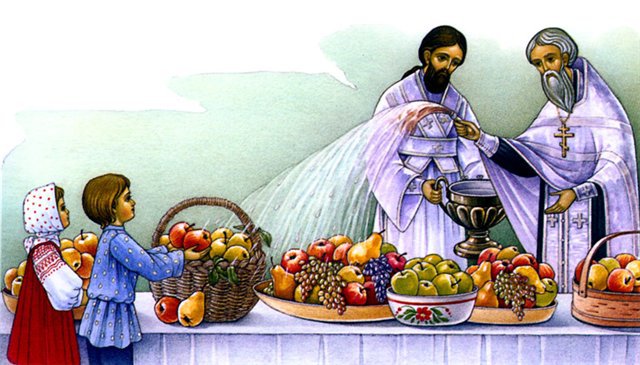
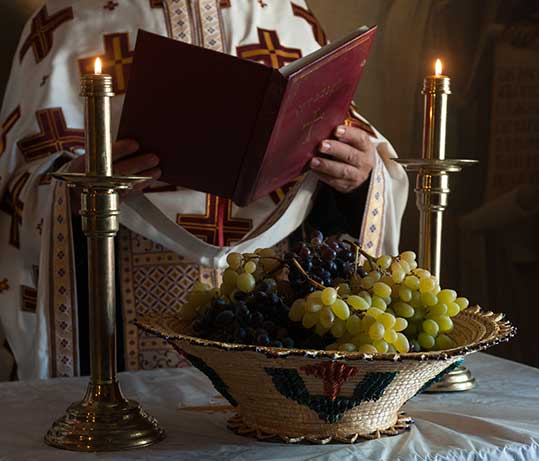
Georgios N. Manolis, Theologian: The Participation of Nature in Worship: the Blessing of the Fruits of the Vine
According to Saint Basil the
Great, nothing exists without due cause, nothing’s fortuitous,
everything has some secret and unexpressed wisdom. Thus, regarding
plants and their fruits, apart from their ecological importance as
producers of eco-systems they’re also schools for rational souls and colleges of the knowledge of God, which train the intellect and lead it from the visible and tangible to the contemplation of things invisible.
Plants form an important element in the
worship of the Orthodox Church. During the Divine Liturgy, bread and
wine are used, the products of grain and grape. During the service of
the Blessing of the Loaves, grain, wine and oil are blessed. Besides, in
accordance with liturgical practice the fruits of the earth, such as
grapes and figs, are offered and blessed once they’re ripe. Indeed, in
general, every action and task linked to the earth and its cultivation
is accompanied either by thanksgiving to the Creator or by supplications
that the tilling and harvesting should provide plenteous amounts of
fine fruit.

There was always a tradition in the
Church that, when the bread and wine were being offered at the
Eucharist, other produce and fruits of the earth could also be offered
and blessed. But to preserve the tradition of offering only bread and
wine at the sacrament of the Divine Eucharist the Church forbade the
custom of presenting non-Eucharistic produce during the actual
celebration of the Eucharist.
All that was allowed by the Church was
the offering of grain and grapes, with the explanation that this
offering took place at the time when fruits ripened and this was to be a
blessing of the first-fruits and was by way of an expression of thanks
to God for the abundance and fertility of the earth. From as early as
the third century we have prayers for the first-fruits, thanksgiving to
God Who had given them for the gladdening and nourishment of people. The
first-fruits were brought to church as a pleasing and grateful gesture
to Him.
As regards the blessing of the fruit of
the vine we can see that this is an ancient tradition of the Church, for
which there are two ceremonies in the Service Book of the Church of
Constantinople and imperial ritual. Therefore according to ancient
custom, the Church always blessed the harvest and the grapes. Indeed, a
canon was introduced establishing that grain and bread be blessed before
they were eaten at the beginning of the harvest.

A continuation of this tradition is the
blessing of the grapes at the feast of the Transfiguration of Christ the
Saviour. We have a manuscript from the 10th century containing a prayer
through which the Church thanks God Who was pleased to ensure that the
fruit ripened, was harvested and brought gladness to people through its
taste. Wine, a product of the grape, was also offered as a gift to be
included in the celebration of the Divine Eucharist. There is also
another, later, prayer which mentions the blessing of only the grapes,
with a clear reference to the spiritual freedom guaranteed by Christ
through the Eucharistic life.
It’s interesting that in certain
liturgical rubrics, the blessing of the fruit of the vine takes place on
the feast of Dormition of the Mother of God, after the Divine Liturgy.
This was the case in Constantinople, where the Patriarch blessed the
grapes on that day, in the church of Our Lady of Blachernae, in the
presence of the Emperor. From other texts, it appears that the offering
took pace at the feast of the Elevation of the Precious Cross. It is
clear, then, that the time of the blessing of the fruit of the vine
depended on the conditions prevailing in nature in each region and on
the time at which they ripened.
If we wish to see the theological
connection between the feast and the blessing of the fruit of the vine,
our thoughts will inevitably turn to the parable of the vine, where
Christ is presented as the true vine. With the blessing of the grapes,
it is emphasized that people have a need of spiritual productivity and a
transformational advancement towards sanctity, glorification by Grace,
and communion with God. Moreover, Christ is the vine which has its roots
in heaven and its branches on earth. The body- though not the root- was
pruned and on the third day thereafter brought forth the fruit of the
Resurrection.
It follows, then, that, with the Lord’s
Transfiguration, at which His glory was revealed, the world is illumined
and glorified. Consequently, creation responds with glorification and
gratitude to this gift and the Church continues to bless the world and
it first-fruits. This blessing of the fruits emphasizes the creation’s
offering of praise and gratitude to the Creator. Besides, the grape is
the fruit that gives us wine, which we offer together with bread so that
they become the Body and Blood of Christ. By partaking of these, we
become one in body and blood with Christ.
We, as people, received the world,
blessed and sanctified, from God’s hands. Between us and our environment
there was harmony and co-operation. The Fall also brought about the
decay of creation, since thereafter it followed the same path as we did.
After our disobedience and estrangement from God we began abusing and
exploiting creation. Nature rebelled numerous times against us and
opposed us, with the result that instead of functioning constructively
and positively towards us, it often became negative and destructive. We
feel it threatens us. The turmoil in our relations with God has brought
about disruption in our relations with His creation, nature.
As Christians, however, we should not
see nature as being de-sanctified but should view it as the creation and
gift of God. We should feel that, in the world, we’re within the
creative love of God. We Christians feel the need to respond to this
love, to take elements from the material world and to offer them to God.
We bring bread and wine, representative elements of the material world,
in thanks to God and, after their sanctification, they’re offered back
to us as the Body and Blood of Christ. In this way, we acquire a
foretaste of the world as it will be transfigured in Christ in the end
times.source and thanks to: www.pemptousia.com
Mittwoch, 17. Juli 2019
Finnish Church celebrates canonization of St. John of Sonkajanranta
Sonkajanranta, Finland, July 15, 2019
On November 29,
the Holy Synod of the Patriarchate of Constantinople announced its
decision to glorify among the saints the holy Martyr and
Confessor John of Sonkajanranta (1884-1918) at the proposal of the
Finnish Orthodox Church, an autonomous body within the
Patriarchate.
Johannes Vasilinpoika Karhapää was an Orthodox missionary who was
killed by the White Guards during the Finnish civil war. Schema-Abbot
John of Valaam was canonized on the same day, which was liturgically
celebrated on June 1.
The liturgical proclamation of this glorification was celebrated on
Saturday at the Church of the Holy Prophetess of God Anna in
Sonkajanranta in southeastern Finland by His Eminence Archbishop Leo
of Helsinki and All Finland, with the concelebration of several other
hierarchs from the Finnish Church, reports the Finnish Church.
A large number of clergy and faithful from throughout Finland,
including relatives of the newly-canonized saint, were present for the
festal Divine Liturgy. The small church was filled to overflowing,
with many faithful watching a broadcast of the service in the
courtyard.
Abp. Leo
addressed the gathered faithful with a sermon about the labors of the
holy Martyr John and Protodeacon Juha Pessie read out the life of the
new saint. Following the Divine Liturgy, a solemn procession was held
with the icon of the saint to a memorial cross erected in his honor
in the 1980s, where a moleben was served.
Following the moleben to St. John, all the guests were treated to a
festive lunch. The official celebrations then finished with the
chanting of an akathist to St. John at the memorial cross. All present
were blessed with the gift of a memorial icon of St. John.
St. John was
born in 1884 in the Sonkajanranta village in Ilomantsi. He married and
had two children, and was married a second time after his wife died
in 1910.
He developed a strong and active Orthodox faith in his childhood. In
response to fervent Lutheran missionary work, St. John founded an
Orthodox school and association as a subdivision of the Sts. Sergius
and Herman Brotherhood that actively countered the Protestant
propaganda.
St. John also worked as a traveling catechist in Ilomantsi, and in
1914, he was appointed as a teacher of religion for the entire Kuopio
Province. His great activity also earned him a number of enemies who
called him a henchman of the tsarist regime and even accused him of
being a spy.
In 1915, the Church of St. Anna, where the glorification of St.
John was celebrated, was built for the school he had founded. St. John
received a number of distinctions for his zealous teaching and
missionary work, though he was also hated as a propagator of the
“Russian faith.” Accusations against him intensified following the
Russian revolution in 1917 and he was also accused of being a
Bolshevik. St. John never responded to any of the heinous accusations.
Eventually he was slandered among the Orthodox faithful as well, and
it was demanded that he be removed from his Church positions. Having
lost the support of the local archbishop as well, St. John was seen as
a criminal in the turmoil of the Finnish civil war.
St. John and his brother were arrested in March 1918 after a small
icon was found in his pocket. They were locked up in the basement of
the Joensuu town hall with other prisoners. He was later shot by a
group of rowdy White Guards. The exact date of his execution is
unclear.
His wife was able to obtain his body only months later, and he was
buried in Ilomantsi with a large group of Orthodox and Lutherans
attending.
***
Troparion, Tone 2
Thy martyr John, O Lord / rejoices crowned as a saint in Heaven /
as the first-begotten of our people, / for spurred on by Thee, he
served for the good of the true faith even unto death. // By his
prayers have mercy upon our souls.
Troparion, Tone 5
The faithful bow to thee today, John, / Instructor of the word of
God, / for difficult was thy path, of fervent faith and Divine
inspiration, / and as an innocent victim brutally murdered / thou dost
abide in the joy of the Heavenly Kingdom. // Therefore we honor thee
as a martyr.
Source and thanks to: http://orthochristian.com
Mittwoch, 27. März 2019
Saint Maximus the Greek, the tireless preacher of Patristic Tradition
During its long historical past the Great Holy Vatopedi Monastery has proved to have played a double role in its spiritual activities. It pursued both a hesychastic life and freedom from worldly care, that are the basics to achieve theosis, and it also sent its saintly children out on missionary work to be the living examples of the Orthodox Athonian Tradition and thus support the people of God, something not alien in the life of the Church through the centuries. We can here say that it excelled in this role so much that the lot of missionary work fell on it not only within Greece but out of it too.
St. Maxim Vatopedinos, known as “St.
Maxim the Greek”, was one of the most erudite monks , who stood out as a
theologian, philosopher and poet during the first half of the 16th century, and became known as “the illuminator of the Russian people.”
He was born in Arta, a town in the
northwest of Greece in 1470. He came from a well-to-do, illustrious and
God-fearing family, and his name was Michael Trivolis. His parents sent
him to school in Arta and then to Corfu. At the age of twenty he went to
Italy, where he studied at the universities of Venice, Padua, Ferrara,
Florence and Milan for fifteen years. E. Golubinski, one of the most
reputable of St. Maxim’ biographers, states that if he had decided to
stay on in Italy, he would have become one of the most eminent
professors at any one of those universities at the time.
But St. Maxim began to search in earnest
for the authentic way of Christian life, because he realized man’s
poverty without God’s grace, after having a taste of the Renaissance
Humanism in Italy where it was at its peak just then. He saw that
moralism had turned people towards the irrational passions of hypocrisy,
greed, inhumanity and vice. He happened to hear about the monastic
community of Mt. Athos and, fervently wishing to reach the highest human
achievement that of theosis, after having a first hand taste of the
futility of all kinds of human glory and wisdom, he decided to become a
monk and dedicate himself to God. So he went to Mt. Athos, this renowned
cradle of Eastern Orthodox Tradition, and finally settled at the Great
Holy Vatopedi Monastery.
An Anchorite in Mt. Athos
At the Vatopedi Monastery he lived a
life of ascesis for about 10 years. He practised the fundamental virtues
of obedience and abstinence, which helped him overcome all human
passions actually, because he cut off his own will, desire, greed and
pride. His unquenchable desire to acquire virtues and his admirable
application of them, made him reach the high virtues of humility,
poverty and love. These virtues turned him into a man of constant
self-sacrifice towards his fellow ascetics and fellow men. At the same
time, by practising constant prayer, he merged his soul with God and
turned it into a temple of the Holy Spirit.
The extensive library of the Monastery
offered spiritual food to the saint. He never stopped taking delight in
its books. His studying of the rare manuscripts of the library, helped
him harvest the wisdom of the preceding hosii of Orthodoxy, while the
example of the other scholarly fathers of the monastery was the
signal-light and guide of his angelic monastic life.
The other fathers of the brotherhood
soon became aware of his cultivated and rich in virtues and charismata
soul, and they entrusted him with some necessary jobs outside the
monastery walls. This gave the saint the chance to help our orthodox
people who were suffering because of their illiteracy, the Turkish yoke
and the heresies from the West.
In 1515, the Tsar Vasilius Ivanovitz,
asked both the Ecumenical Patriarchate and the “Protos” of Mt. Athos to
send him an experienced scholar and virtuous monk to translate various
ecclesiastic texts into the Russian language and also to emend the
incorrect translations and copies of the Holy Bible and the Patristic
texts in existence. Monk Savvas from Vatopedi was initially chosen, but
he declined because of his advanced years; then the lot fell to the
eminent monk Maxim.
His going to Russia
Maxim left Mt. Athos in 1516. The Moscow
Metropolitan Valaam and the Tsar Vasilius Ivanovitz welcomed the
Athonian monk and his followers on behalf of the Russian people.
Unfortunately, during that time the Russian nation was suffering because
of various newfangled ideas that had also found their way into the
orthodox ecclesiastic books maybe not inadvertently. Maxim worked hard
and wrote many books of spiritual content, translations, emendations and
hermeneutic works. His upright and virtuous behaviour soon attracted
the Tsar, the Metropolitan and the simple people together with some
prominent men that saw in him the wise monk, who- with God’s help- could
solve, by his wise teachings and advice, the many and various problems
of people from all walks of life. In this way he began his advisory work
mainly towards the Russian ruler and the Metropolitan, who governed the
state and the church.
It is worth mentioning here that St.
Maxim Vatopedinos was the first to introduce the Russians to the ancient
Greek philosophy and literature due to his long scientific studies in
Italy. He was also the first to introduce printing in Russia, having
close ties with the famous scholar and printer Aldus Manutius. In
general, the illuminator and isapostle Maximus worked wisely in various
ways, taking care to educate as many people as possible, who in turn
continued the colossal work of the Orthodox enlightenment of the Russian
people for the glory and joy of the Church God. All these cultural
activities of St. Maxim underline the various and beneficial efforts of
the Saint, that prove him to be not only a missionary but also a
civilization worker for the Russian people, at a time when Russia was in
a state of illiteracy and ignorance.
St. Maxim missionary work lasted for
eight years. His confessional work, though, resulted in a heavy cross he
had to bear, or, to put it in other words, the Devil, the enemy of all
truth tried to destroy Maxim’s work but he failed, because the grain of
seed ‘ fell into the good ground, and grew, and brought forth fruit a
hundredfold’ ( Luk. 8. 8)
Conflict with the state and church authorities
We have to make it quite clear here that
because of the many wrongdoings of certain political and church people-
which sometimes happened because of ignorance- the Athonite Father had
to protest and castigate some people, based on the teachings of the
Bible and according to the authority bestowed upon him by the Russian
Church and the Emperor. Unfortunately, this, instead of helping
ameliorate things, it bought him the enmity of the people concerned.
Among them we find the Tsar himself and the new Metropolitan of Russia
Daniel, who did not understand the real concern of the saint for the
salvation and the adherence to the right dogma of the Russian Church.
Dienstag, 26. März 2019
Dachau 1945: The Souls of All Are Aflame
In 1945, a Paschal Liturgy like no other was performed. Just days after their liberation by the US military on April 29, 1945, hundreds of Orthodox Christian prisoners at the Dachau concentration camp gathered to celebrate the Resurrection service and to give thanks.
by Douglas Cramer
The Dachau concentration camp was opened in 1933 in a former gunpowder factory. The first prisoners interred there were political opponents of Adolf Hitler, who had become German chancellor that same year. During the twelve years of the camp's existence, over 200,000 prisoners were brought there. The majority of prisoners at Dachau were Christians, including Protestant, Roman Catholic, and Orthodox clergy and lay people.
Countless prisoners died at Dachau, and hundreds were forced to participate in the cruel medical experiments conducted by Dr. Sigmund Rascher. When prisoners arrived at the camp they were beaten, insulted, shorn of their hair, and had all their belongings taken from them. The SS guards could kill whenever they thought it was appropriate. Punishments included being hung on hooks for hours, high enough that heels did not touch the ground; being stretched on trestles; being whipped with soaked leather whips; and being placed in solitary confinement for days on end in rooms too small to lie down in.
The abuse of the prisoners reached its end in the spring of 1945. The events of that Holy Week were later recorded by one of the prisoners, Gleb Rahr. Rahr grew up in Latvia and fled with his family to Nazi Germany when the Russians invaded. He was arrested by the Gestapo because of his membership in an organization that opposed both fascism and communism. Originally imprisoned in Buchenwald, he was transported to Dachau near the end of the war.
In fact, Rahr was one of the survivors of the infamous “death trains,” as they were called by the American G.I.’s who discovered them. Thousands of prisoners from different camps had been sent to Dachau in open rail cars. The vast majority of them died horrific deaths from starvation, dehydration, exposure, sickness, and execution.
In a letter to his parents the day after the liberation, G.I. William Cowling wrote, “As we crossed the track and looked back into the cars the most horrible sight I have ever seen met my eyes. The cars were loaded with dead bodies. Most of them were naked and all of them skin and bones. Honest their legs and arms were only a couple of inches around and they had no buttocks at all. Many of the bodies had bullet holes in the back of their heads.”
Marcus Smith, one of the US Army personnel assigned to Dachau, also described the scene in his 1972 book, The Harrowing of Hell.
Refuse and excrement are spread over the cars and grounds. More of the dead lie near piles of clothing, shoes, and trash. Apparently some had crawled or fallen out of the cars when the doors were opened, and died on the grounds. One of our men counts the boxcars and says that there are thirty-nine. Later I hear that there were fifty, that the train had arrived at the camp during the evening of April 27, by which time all of the passengers were supposed to be dead so that the bodies could be disposed of in the camp crematorium. But this could not be done because there was no more coal to stoke the furnaces. Mutilated bodies of German soldiers are also on the ground, and occasionally we see an inmate scream at the body of his former tormentor and kick it. Retribution!
Rahr was one of the over 4,000 Russian prisoners at Dachau at the time of the liberation. The liberated prisoners also included over 1,200 Christian clergymen. After the war, Rahr immigrated to the United States, where he taught Russian History at the University of Maryland. He later worked for Radio Free Europe. His account of the events at Dachau in 1945 begins with his arrival at the camp:
April 27th: The last transport of prisoners arrives from Buchenwald. Of the 5,000 originally destined for Dachau, I was among the 1,300 who had survived the trip. Many were shot, some starved to death, while others died of typhus. . . .April 28th: I and my fellow prisoners can hear the bombardment of Munich taking place some 30 km from our concentration camp. As the sound of artillery approaches ever nearer from the west and the north, orders are given proscribing prisoners from leaving their barracks under any circumstances. SS-soldiers patrol the camp on motorcycles as machine guns are directed at us from the watch-towers, which surround the camp.April 29th: The booming sound of artillery has been joined by the staccato bursts of machine gun fire. Shells whistle over the camp from all directions. Suddenly white flags appear on the towers—a sign of hope that the SS would surrender rather than shoot all prisoners and fight to the last man. Then, at about 6:00 p.m., a strange sound can be detected emanating from somewhere near the camp gate which swiftly increases in volume. . . .
The sound came from the dawning recognition of freedom. Lt. Col. Walter Fellenz of the US Seventh Army described the greeting from his point of view:
Several hundred yards inside the main gate, we encountered the concentration enclosure, itself. There before us, behind an electrically charged, barbed wire fence, stood a mass of cheering, half-mad men, women and children, waving and shouting with happiness—their liberators had come! The noise was beyond comprehension! Every individual (over 32,000) who could utter a sound, was cheering. Our hearts wept as we saw the tears of happiness fall from their cheeks.
Rahr’s account continues:
Finally all 32,600 prisoners join in the cry as the first American soldiers appear just behind the wire fence of the camp. After a short while electric power is turned off, the gates open and the American G.I.’s make their entrance. As they stare wide-eyed at our lot, half-starved as we are and suffering from typhus and dysentery, they appear more like fifteen-year-old boys than battle-weary soldiers. . . .An international committee of prisoners is formed to take over the administration of the camp. Food from SS stores is put at the disposal of the camp kitchen. A US military unit also contributes some provision, thereby providing me with my first opportunity to taste American corn. By order of an American officer radio-receivers are confiscated from prominent Nazis in the town of Dachau and distributed to the various national groups of prisoners. The news comes in: Hitler has committed suicide, the Russians have taken Berlin, and German troops have surrendered in the South and in the North. But the fighting still rages in Austria and Czechoslovakia....Naturally, I was ever cognizant of the fact that these momentous events were unfolding during Holy Week. But how could we mark it, other than through our silent, individual prayers? A fellow-prisoner and chief interpreter of the International Prisoner's Committee, Boris F., paid a visit to my typhus-infested barrack—“Block 27”—to inform me that efforts were underway in conjunction with the Yugoslav and Greek National Prisoner's Committees to arrange an Orthodox service for Easter day, May 6th.There were Orthodox priests, deacons, and a group of monks from Mount Athos among the prisoners. But there were no vestments, no books whatsoever, no icons, no candles, no prosphoras, no wine. . . . Efforts to acquire all these items from the Russian church in Munich failed, as the Americans just could not locate anyone from that parish in the devastated city. Nevertheless, some of the problems could be solved. The approximately four hundred Catholic priests detained in Dachau had been allowed to remain together in one barrack and recite mass every morning before going to work. They offered us Orthodox the use of their prayer room in “Block 26,” which was just across the road from my own “block.”The chapel was bare, save for a wooden table and a Czenstochowa icon of the Theotokos hanging on the wall above the table—an icon which had originated in Constantinople and was later brought to Belz in Galicia, where it was subsequently taken from the Orthodox by a Polish king. When the Russian Army drove Napoleon's troops from Czenstochowa, however, the abbot of the Czenstochowa Monastery gave a copy of the icon to czar Alexander I, who placed it in the Kazan Cathedral in Saint-Petersburg where it was venerated until the Bolshevik seizure of power. A creative solution to the problem of the vestments was also found. New linen towels were taken from the hospital of our former SS-guards. When sewn together lengthwise, two towels formed an epitrachilion and when sewn together at the ends they became an orarion. Red crosses, originally intended to be worn by the medical personnel of the SS guards, were put on the towel-vestments.On Easter Sunday, May 6th (April 23rd according to the Church calendar)—which ominously fell that year on Saint George the Victory-Bearer's Day—Serbs, Greeks and Russians gathered at the Catholic priests’ barracks. Although Russians comprised about 40 percent of the Dachau inmates, only a few managed to attend the service. By that time “repatriation officers” of the special Smersh units had arrived in Dachau by American military planes, and begun the process of erecting new lines of barbed wire for the purpose of isolating Soviet citizens from the rest of the prisoners, which was the first step in preparing them for their eventual forced repatriation.In the entire history of the Orthodox Church there has probably never been an Easter service like the one at Dachau in 1945. Greek and Serbian priests together with a Serbian deacon wore the make-shift “vestments” over their blue and gray-striped prisoner’s uniforms. Then they began to chant, changing from Greek to Slavonic, and then back again to Greek. The Easter Canon, the Easter Sticheras—everything was recited from memory. The Gospel—“In the beginning was the Word”—also from memory.And finally, the Homily of Saint John Chrysostom—also from memory. A young Greek monk from the Holy Mountain stood up in front of us and recited it with such infectious enthusiasm that we shall never forget him as long as we live. Saint John Chrysostomos himself seemed to speak through him to us and to the rest of the world as well! Eighteen Orthodox priests and one deacon—most of whom were Serbs—participated in this unforgettable service. Like the sick man who had been lowered through the roof of a house and placed in front of the feet of Christ the Savior, the Greek Archimandrite Meletios was carried on a stretcher into the chapel, where he remained prostrate for the duration of the service.
Other prisoners at Dachau included the recently canonized Bishop Nikolai Velimirovich, who later became the first administrator of the Serbian Orthodox Church in the US and Canada; and the Very Reverend Archimandrite Dionysios, who after the war was made Metropolitan of Trikkis and Stagnon in Greece.
Fr. Dionysios had been arrested in 1942 for giving asylum to an English officer fleeing the Nazis. He was tortured for not revealing the names of others involved in aiding Allied soldiers and was then imprisoned for eighteen months in Thessalonica before being transferred to Dachau. During his two years at Dachau, he witnessed Nazi atrocities and suffered greatly himself. He recorded many harrowing experiences in his book Ieroi Palmoi. Among these were regular marches to the firing squad, where he would be spared at the last moment, ridiculed, and then returned to the destitution of the prisoners’ block.
After the liberation, Fr. Dionysios helped the Allies to relocate former Dachau inmates and to bring some normalcy to their disrupted lives. Before his death, Metropolitan Dionysios returned to Dachau from Greece and celebrated the first peacetime Orthodox Liturgy there. Writing in 1949, Fr. Dionysios remembered Pascha 1945 in these words:
In the open air, behind the shanty, the Orthodox gather together, Greeks and Serbs. In the center, both priests, the Serb and the Greek. They aren't wearing golden vestments. They don't even have cassocks. No tapers, no service books in their hands. But now they don't need external, material lights to hymn the joy. The souls of all are aflame, swimming in light.Blessed is our God. My little paper-bound New Testament has come into its glory. We chant “Christ is Risen” many times, and its echo reverberates everywhere and sanctifies this place.Hitler's Germany, the tragic symbol of the world without Christ, no longer exists. And the hymn of the life of faith was going up from all the souls; the life that proceeds buoyantly toward the Crucified One of the verdant hill of Stein.
On April 29, 1995—the fiftieth anniversary of the liberation of Dachau—the Russian Orthodox Memorial Chapel of Dachau was consecrated. Dedicated to the Resurrection of Christ, the chapel holds an icon depicting angels opening the gates of the concentration camp and Christ Himself leading the prisoners to freedom. The simple wooden block conical architecture of the chapel is representative of the traditional funeral chapels of the Russian North. The sections of the chapel were constructed by experienced craftsmen in the Vladimir region of Russia, and assembled in Dachau by veterans of the Western Group of Russian Forces just before their departure from Germany in 1994. The priests who participated in the 1945 Paschal Liturgy are commemorated at every service held in the chapel, along with all Orthodox Christians who lost their lives “at this place, or at another place of torture.”
Christ Opening the Gates of Dachau
Douglas Cramer is Chair of the Department of Internet Ministry of the Antiochian Archdiocese, and editor of Antiochian.org. He is a writer, editor, and graphic designer with over twenty years of experience in the field of communications. Douglas has served as managing editor of AGAIN Magazine and as staff writer for Orthodox Christian Network. He is a member of Holy Trinity Orthodox Church of Santa Fe, New Mexico. This article originally appeared in AGAIN Magazine Vol. 26 No. 1.
http://www.antiochian.org/souls-aflame
Mittwoch, 20. März 2019
Saint Alexios, the Man of God
Varied are the paths upon which God leads
those who desire to please Him and fulfill His law. There lived in Rome
at the time of Emperor Honorius a high-ranking dignitary, Euphemianus,
who was highly respected and extremely wealthy. He and his wife,
Aglaida, led a God-pleasing life. Even though he was wealthy,
Euphemianus sat at the table only once a day, after the setting of the
sun. He had an only son, Alexios, who was compelled to marry when he
became an adult. But, on the night of the wedding, Alexios left not only
his wife but also the home of his father. He boarded a boat and arrived
at the city of Edessa in Mesopotamia, where there was the wondrous
image of our Lord, sent there by our Lord Himself to King Abgar. Having
venerated this image, Alexios clothed himself in the garb of a beggar.
As such, he lived in the city for seventeen years, continually praying
to God in the vestibule of the Church of the Theotokos. When it became
known that he was a holy man, he became frightened of the praise of men,
departed Edessa, boarded a boat, and traveled to Laodicea. According to
God’s providence, the boat was carried off-course and sailed all the
way to Rome. Considering this to be the hand of God, Alexios decided to
go to the house of his father and there, unknown, continue his life of
self-denial. His father did not recognize him but of charity allowed him
to live in his courtyard in a hut. Alexios remained there for seventeen
years, living only on bread and water. Mistreated by the servants in
various ways, he endured everything to the end. When his end approached,
he wrote a letter, clenched it in his hand, and then lay down and died,
on March 17, 411. At the same time there was a revelation in the Church
of the Twelve Apostles. In the presence of the emperor and the
patriarch a voice was heard which said: “Seek out the Man of God.”
Shortly after that, it was revealed that this “Man of God” resided at
the house of Euphemianus. The emperor along with the pope and an entire
retinue arrived at the home of Euphemianus, and after a lengthy
discussion they learned that the beggar was that “Man of God.” When they
entered his hut, they found Alexios dead, but his face shone like the
sun. From the letter his parents learned that he was their son Alexios.
And his bride, who for thirty-four years had lived without him, learned
that he was her husband. All were overcome with immense grief and pain.
Later they were comforted, seeing how God glorified His chosen one. By
touching his body, many of the sick were healed, and from his body
flowed a sweet-smelling oil. His body was entombed in a coffin of marble
and jasper. His head is preserved in the Church of St. Laurus in the
Peloponnese.
Source: St. Nikolai Velimirovic, The Prologue of Ohrid – Volume One.
ApolytikionThough thou didst bud forth from a renowned and notable root, and though thou didst blossom from a city famed for her great imperial dignity, yet didst thou scorn all things as corruptible and fleeting, striving to be joined to Christ thy Master for ever. Entreat Him, O Alexis most wise, fervently for our souls.
Kontakion
As we celebrate today with fitting rev’rence the all-holy festival of Saint Alexis the all-blest, with hymns we praise him and cry aloud: Rejoice, thou gladsome adornment of righteous men.
source:gometropolis.org
Dienstag, 5. März 2019
New Saints Archpriest Paul Dernov and his sons Boris, Gregory and Simeon
Four new saints have been added to the calendar of the Russian
Orthodox Church. On February 27, the 101st anniversary of the
martyrdom of Archpriest Paul Dernov and his sons Boris, Gregory, and
Simeon, the holy family was liturgically glorified among as saints
among the Synaxis of Russian New Martyrs and Confessors, reports the
Information Department of the Tatarstan Metropolia.
Photo: tatmitropolia.ru
Paul
Alexandrovich Dernov was born on January 12, 1870 in the family of a
local priest in the Vyatka Governate. He graduated from the Kazan
Theological Academy as a kandidat of theology at the age of 24.
He was ordained as a priest in 1894 and appointed rector of the
Nativity of the Theotokos Church in Elabuga. Fr. Paul served his
entire ministry there, working to cultivate the principles of
Christian morality in the educational institutions entrusted to him.
Photo: tatmitropolia.ru
Fr. Paul’s sons were all born and raised and educated in Elabuga.
The communist terror began in the city in 1918. After delivering
striking homilies, reading the epistles of Patriarch Tikhon in church,
and denouncing those who profane the church, Fr. Paul was denounced
as the main organizer of an uprising in Elabuga. Fr. Paul was
arrested on February 12. Drunk soldiers led him onto the ice of the
Toima River and shot him on the night of February 13-14.
The next morning, before news of his death reached his family, his
sons Boris, Gregory, and Simeon went in search of their father and
were arrested by soldiers. Eyewitnesses testify that the brothers
publicly professed the Orthodox faith while in the soldiers’ custody.
They were taken to the city dam and shot with rifles. The soldiers
then finished them off with bayonets.
The Divine Liturgy and glorification were celebrated by His Eminence
Metropolitan Theophan of Kazan and Tatarstan with His Grace Bishop
Methodius of Almetyevsk and Bugulma, His Grace Bishop Parmen of
Chistopol and Nizhnekamsk, and a number of local clergy, in the
Cathedral of Christ the Savior in Elabuga, Tatarstan.
New Martyr Paul
delivered his final sermon in the Elabuga cathedral, for which he and
his three sons were shot a few days later.
Among those present for the glorification were Fr. Paul’s
granddaughter Anna Filippova, clergy and monastics of the metropolia,
students of the Kazan Seminary, and numerous faithful.
Before the Liturgy, the final memorial litiya was served for Fr.
Paul and his sons Boris, Gregory and Simeon. During the Small Entrance
in the Divine Liturgy, the rite of glorification was celebrated, with
the resolution of the Russian Holy Synod of October 15 on their
glorification being read out from the ambo. Their day of commemoration
is set as February 14/27, the day of their martyrdom.
An icon of the newly-glorified saints was carried out to the center of
the cathedral, and Met. Theophan blessed all the faithful with the
icon during the singing of their troparion and kontakion. The life of
the new saints was read before Communion.
At the end of
the Liturgy, the clergy and faithful sang the glorification to Sts.
Paul, Boris, Gregory, and Simeon in the middle of the church before
their holy icon.
Met. Theophan then addressed the gathered faithful with a homily,
calling on them to ever honor the memory of the newly-glorified
saints, turning to them in prayer, and passing on their memory to
future generations.
“I believe that this is the mercy of God, sent down to the city of
Elabuga, to our Tatarstan land and to the whole Russian land, for the
New Martyrs are our glory and our hope. We are weak in faith, weak in
piety, but through the prayers of the New Martyrs the Lord will
certainly strengthen us,” Met. Theophan preached.
Dienstag, 13. Dezember 2016
SAINT PAISIOS THE JESUS PRAYER - MORNING AND EVENING, INTONE THE FOLLOWING PRAYERS WITH EACH KNOT OF YOUR PRAYER ROPE
1. Grant peace O Lord, to the whole world.
2. Lord Jesus Christ have mercy on our
Church and on Holy Orthodoxy.
3. Lord Jesus Christ have mercy on our
bishop and his synod.
4. Lord Jesus Christ have mercy on all
Orthodox Christians throughout the world both clergy and laity.
5. Lord Jesus Christ have mercy on my
spiritual father and his attendants.
6. Lord Jesus Christ have mercy on our
armed forces.
7. Lord Jesus Christ have mercy on the
leaders of our country.
8. Lord Jesus Christ have mercy on those
who hate us, those who love us and those who pray for us.
9. Lord Jesus Christ have mercy on our
parents, on our godparents and on our teachers.
10. Lord Jesus Christ have mercy on our relatives,
both spiritual and blood relatives.
11. Lord Jesus Christ have mercy on the
elderly and the monastics.
12. Lord Jesus Christ have mercy on the
infants, the defenseless and the weak.
13. Lord Jesus Christ have mercy on our
student youth.
14. Lord Jesus Christ have mercy on our
adolescent youth.
15. Lord Jesus Christ have mercy on the
drug addicted, the alcoholics and those who smoke.
16.
Lord Jesus Christ have mercy on the parents of Orthodox Christian
families.
17. Lord Jesus Christ have mercy on our
pregnant mothers, wives and sisters.
18. Lord Jesus Christ have mercy on the
widows and the orphans.
19. Lord Jesus Christ have mercy on
estranged couples; our brothers and sisters who are tempted.
20. Lord Jesus Christ have mercy on those
who are sick in both body and soul.
21. Lord Jesus Christ have mercy on those
who give alms and those who work in monastic communities and our parishes.
22. Lord Jesus Christ have mercy on those who
make pilgrimages to Monasteries and Churches.
23. Lord Jesus Christ have mercy on those who
are traveling by land, sea and air; the imprisoned and the disillusioned.
24. Lord Jesus Christ have mercy on those
who are mourning and grieving.
25. Lord Jesus Christ have mercy on our judges
and politicians.
26. Lord Jesus Christ have mercy on those
who have been led astray and those who blaspheme our Orthodox Church.
27.
Lord Jesus Christ have mercy on us and grant us peace.
28.
Lord Jesus Christ protect us from sickness, anger and danger; enlighten our
doctors and the nurses.
29. Lord Jesus Christ protect us from
hunger, need and adversity.
30. Lord Jesus Christ protect us from heat,
fire and earthquakes.
31. Lord Jesus Christ protect us from the catastrophes
of floods, fire, freezing and war.
32. Lord Jesus Christ give eternal rest to
the souls of our fathers, mothers, brothers, sisters, relatives and all who
have gone on to their eternal rest.
33. Lord Jesus Christ have mercy on me a
sinner.
The
Apostle Paul admonishes us in his First Letter to the Thessalonians: “Rejoice
always, pray without ceasing, in everything give thanks for this is the will of
God in Christ Jesus for you.” (1 Thess. 5:17).
Praying with the prayer rope has no limitations. As much as a person can bring themselves to
pray with the 33, the 50 or the 100 knot prayer rope, should constantly repeat:
“Lord God Jesus Christ, Son of God, have mercy on me a sinner.”
Translated from the Greek by:
+Fr. Constantine (Charles) J. Simones,
November 26, 2015, Waterford, CT, USA,
Abonnieren
Posts (Atom)