Posts mit dem Label Theology werden angezeigt. Alle Posts anzeigen

Dienstag, 24. Dezember 2019

CHRISTMAS : TRUTH AND MYTHS


By Protopresbyter Fr. George D. Metallinos
Professor Emeritus of the Athens University School of Theology

With His Incarnation and Birth, the Godman Jesus Christ actualizes the purpose that man was fashioned for, which was the eventual emergence of the Godman in History - the union of the created creature with the Uncreated Creator. 
The purpose of the Incarnation was man’s deification (theosis).
God becomes man, in order to make Adam God” (Christmas Troparion hymn).
He became man, so that we might be deified” (Athanasius the Great).
For God became man, and man, God.” (John Chrysostom)
To a moralist’s mindset, the choice of the term “deification” (theosis) used by Fathers such as Athanasius the Great is scandalous. 
That is why moralists speak of “moral theosis”:  they are afraid to accept that man is actually transformed “by Grace” through theosis, into that which the Triune God is “by nature” (uncreated, beginning-less, immortal). It is for this reason that Christmas is directly linked to the Crucifixion and the Resurrection, but also to the Ascension and the Pentecost.  Christ – the Godman – carved the path upon which every person being saved is invited to walk, when becoming united with Him.
The Incarnation and the Nativity lead to the Pentecost – the event of man’s in-Christ deification – that is, within the corpus of Christ.  If Christ’s Nativity is the Birth of God as a man, the Pentecost is man’s completion as a God by Grace.  With our Baptism, we partake of the incarnation, the death and the resurrection of Christ; we too experience “our Christmas” – our regeneration.  As for the Saints who attain union with Christ (theosis), they partake of the Pentecost and thus reach a re-born man’s in-Christ completion and fulfilment.  Ecclesiastically speaking, this is man’s realization – in other words, the fulfilment of his life’s purpose.
As tiresome as the theological word may seem, and especially to the theologically uninitiated person, it basically expresses the reality of our Saints’ experience.  It is through this experience alone that Christmas can be understood ecclesiastically – that is, “Christ-centredly”. Reversely, the inability of the non-reborn-in-Christ person to give meaning to Christmas has led to the rise of certain myths about it.  With their inability to experience Christmas, those who have not savoured a Holy-Spiritual life tend to mythologize about it, within the confines of fantasy and fiction, thus losing its true meaning.  As we shall in fact see, this disorientation is not always linked to the per se denial of the mystery, but to the inability to experience it, which inevitably leads to its misinterpretation.
A first mythological answer to the question of Christmas is given by heresy, that is, by a speculative and groundless (=lacking in experience) theology.
Docetism – the worst heresy of all time – asserted an imaginary incarnation of God the Logos; that is, a “seemingly present” God within endo-cosmic reality.  One could ask: for what reason?   Well, the Docetes of every era cannot –within the limits of their logic– accept the incarnation and the birth of God as a human being. Having transformed themselves into self-appointed defenders of God’s authority, they are ashamed to accept something that God Himself had chosen for our salvation, which was the path of maternity: that is, for Him to have been born of a Mother, even though She was none other than the purest creation in the entire History of mankind: the Most Holy Virgin.
All of the aforementioned believers can be ranked among the “hyper-exaggerating” Orthodox (according to Saint Gregory the Theologian), because Docetism led to the denial of Christ’s human status, in the form of Monophysitism (=having one nature).  These are the conservatives, the ritualists, the easily scandalized.  Truth, reality and historicity are scandals, in the minds of all of these.  Whereas the former reject Christ’s divinity, the latter deny His humanity. And yet, Orthodoxy – that is, Christianity in its authenticity – is the “most historic religion” according to the ever-memorable Fr. George Florovsky.  It lives within the reality of God’s energies for our salvation and accepts them with the realism displayed by the Holy Mother: “Behold, the handmaiden of the Lord; may it be to me, according to Your word”!  (Luke 1:38).   “Pilate also in the Creed”, says a charming Serbian maxim.  Because Pilate, as the most spineless officer in History but nevertheless an existent historical personage, actually confirms the historical truth of the Gospel.  Anyway, in spite of the Docetes, God the Logos “became flesh (a man) and dwelt among us, and we have beheld His glory (the uncreated light of His divinity)” (John 1:14).  “For in Him dwells all the entire fullness of Godhead, bodily” (Coloss.2:9) – in other words, He is fully God and fully human.
The incarnation and the birth of the Godman is a scandal for human wisdom, which abolishes and negates itself when it hastens to characterize as “folly” the mystery of Christ that culminates in His crucifixional death (1 Cor.1:23).  Is it ever possible for God to have reached such a degree of self-vacating, that He would die on the Cross as Godman?  That is precisely what scandalizes the wise of the world. To them, the “gods” of this world usually sacrifice people for themselves; they do not sacrifice themselves for the people.  So, how can they possibly accept the mystery of the Divine Selflessness?  “For thus did God love the world, that He gave (sacrificed) His only-begotten Son […] that the world be saved through Him”  (John3:16,17).  Within the confines of “logical” or “natural” theologizing , the divine element of Jesus Christ’s Person is eliminated, leaving only the human one, which is likewise misconstrued and misinterpreted, because -historically speaking- there is not a man-Christ, only the Godman-Christ.  The union of God and man in the Person of God the Logos is not only “unconfused”; it is also “indivisible”. The “logical” interpretations pertaining to the Person of Christ are proven to be irrational, inasmuch as they are unable to logically conceive something that is “above logic”.
The legal-juridical conscience likewise sees scandal in the Person of Christ; it seeks social expedience in the Incarnation and it too resorts to a myth, when it does not surrender itself to the Divine Logos.  Through their renowned scholastic, Anselm (†1109), the Franks concocted the myth on the “satisfaction of divine atonement”: God the Logos is incarnated, in order to be crucified-sacrificed and thus provide satisfaction for the offense that man’s sin had caused God! 
Whatever prevailed at the time in Frankish feudal society was projected (mythologically) onto God, Who was given the status of a super-emperor in the Franco-German imagination.
So what, if John cries out: “for thus God loved the world, that He gave His only-begotten Son” (3:16), or Paul: “But God demonstrates His own love toward us, in that while we were still sinners, Christ died for us” (Rom.5:8)?  No!  The Western (or westernized) man will be taught to cry out that “it was to take revenge” and “He sought satisfaction” – which is how a “Christianity” of another kind was fashioned: a Christianity that does not differ from fiction, seeing that it projects our imagination and our superstitions onto God.  The rationalizing and the legalization of the mystery of the Godman is the greatest threat to Christianity throughout History.
The religious (ritualistic) conscience lives the “scandal” of the Incarnation by having resorted to the “religionizing” of the Faith.  It exhausts the meaning of Christmas with rituals and loses their true purpose, which is the “adoption” (theosis): “that we might enjoy the adoption as sons” (Gal.4:5).  It is the scandal of Pharisaism, even if it is called Christianity.
But there are also the enemies of the “Child”, who suffer from the scandal of authority. Herodism!  The potentates – or, rather, they “who consider themselves rulers” (who think they rule -Mark 10:42), like Herod, see a rival in the newborn Christ and a threat to their interests.  That is why they “seek the young child’s life” (Matth.2:20). By doing so, they misinterpret the true character of Christ’s regal status, which “is never ending”.  Christ, as King of all Creation, is its only true Lord, creator and saviour, unlike the Herods of this world, who unhesitatingly commit murder in order to hold on to their authority.
Saint Gregory the Theologian (P.G.36,516) provides the potential for a correct approach to Christmas: “Now therefore, let us celebrate, not in a festive manner but divinely; not in an earthly manner but an unearthly one; not that which is our own, but that which is the other’s (=not ourselves; let us rather honour Christ) - even more so, that which is the Lord’s; not that which is of infirmity, but of healing; not that which was formed, but that which has been re-formed”.


source and gratitude to: www.impantokratoros.gr

Sonntag, 15. Dezember 2019

Protopresbyter fr. Georgios Metallinos passed away


The Protopresbyter, Father Georgios Metallinos, was born in Corfu in 1940 and completed his basic education in 1958. He was awarded a BA in theology (1958-1962) and philology (1964-1967) from the University of Athens.
After completing his military service (1963-1965), he was appointed scientific assistant in Patristics and he pursued postgraduate studies in West Germany (Bonn and Cologne) in 1969, where he remained until 1975. In the meantime, he did archival studies and research in England.
In 1971 he became clergyman in Germany and held a PhD in Theology (Athens) and a PhD in Philosophy and History (Cologne).
Since 1984 he has been a professor at the Faculty of Theology at the University of Athens, where he has been teaching History of Spiritual Life during the post-Byzantine period, History and Theology of Worship and Byzantine History. He served as dean of the School of Theology from 9/1/2004 to 8/31/2007. Afterwards, he retired and was given the title of emeritus.
He served at Saint Antipas University Church located in the Department of Dentistry in Goudi.
  
source: orthodoxtimes.com


On Thursday, December 19, 2019, Protopresbyter Father Giorgos Metallinos, a prominent Greek theologian, historian, author, and professor, passed away at the age of 79, leaving behind his wife Barabara, three children and ten grandchildren.
Father Giorgos was a much loved and important theologian of the Greek Orthodox Church, as he was an author to over 40 significant books and essays. He was distinguished by his faithfulness to the Orthodox Church,  bringing to light a lot of history about the Greek Church, especially in the modern age, and teaching theology was one of his main passions.

Father Metallinos was born on March 11, 1940, in Kerkyra, where he attended school. He went on to graduate at the University of Athens in Theology and Classical Literature. After his Military service was completed in 1965, he became a research assistant at the Department of Patrology and then went to Germany for post-graduate studies until 1975. During this time he also went to London where he conducted research studies. In 1971, he was ordained a deacon and a presbyter and became Doctor of Theology (University of Athens) and Doctor of Philosophy-History (University of Cologne).
In 1985 he became a Professor at the School of Theology at the University of Athens, teaching History of Spirituality during the Post-Byzantine era, Theology of Worship and Byzantine History. He also served as Dean of the School of Theology between 2004 and 2007.

source:  greekcitytimes.com


Mittwoch, 7. August 2019

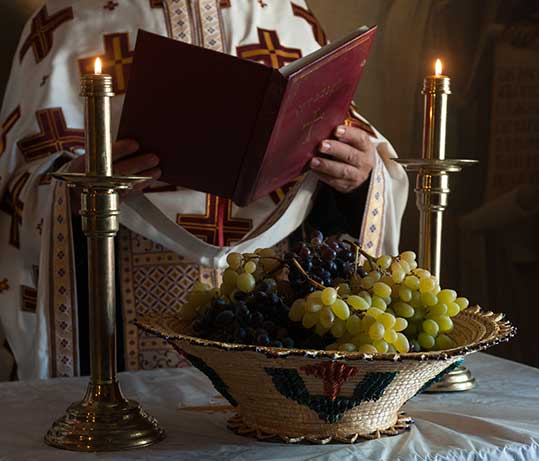
Georgios N. Manolis, Theologian: The Participation of Nature in Worship: the Blessing of the Fruits of the Vine


According to Saint Basil the Great, nothing exists without due cause, nothing’s fortuitous, everything has some secret and unexpressed wisdom. Thus, regarding plants and their fruits, apart from their ecological importance as producers of eco-systems they’re also schools for rational souls and colleges of the knowledge of God, which train the intellect and lead it from the visible and tangible to the contemplation of things invisible.
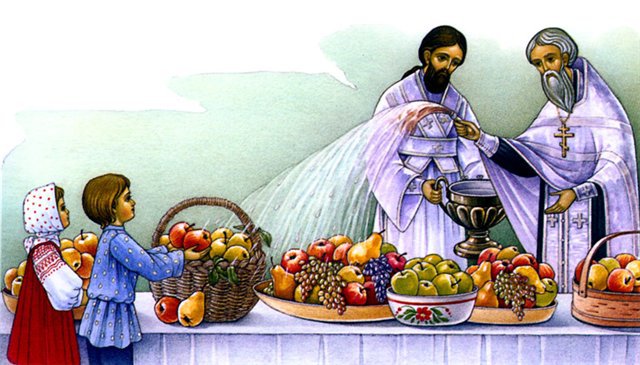
Plants form an important element in the worship of the Orthodox Church. During the Divine Liturgy, bread and wine are used, the products of grain and grape. During the service of the Blessing of the Loaves, grain, wine and oil are blessed. Besides, in accordance with liturgical practice the fruits of the earth, such as grapes and figs, are offered and blessed once they’re ripe. Indeed, in general, every action and task linked to the earth and its cultivation is accompanied either by thanksgiving to the Creator or by supplications that the tilling and harvesting should provide plenteous amounts of fine fruit.

There was always a tradition in the Church that, when the bread and wine were being offered at the Eucharist, other produce and fruits of the earth could also be offered and blessed. But to preserve the tradition of offering only bread and wine at the sacrament of the Divine Eucharist the Church forbade the custom of presenting non-Eucharistic produce during the actual celebration of the Eucharist.
All that was allowed by the Church was the offering of grain and grapes, with the explanation that this offering took place at the time when fruits ripened and this was to be a blessing of the first-fruits and was by way of an expression of thanks to God for the abundance and fertility of the earth. From as early as the third century we have prayers for the first-fruits, thanksgiving to God Who had given them for the gladdening and nourishment of people. The first-fruits were brought to church as a pleasing and grateful gesture to Him.
As regards the blessing of the fruit of the vine we can see that this is an ancient tradition of the Church, for which there are two ceremonies in the Service Book of the Church of Constantinople and imperial ritual. Therefore according to ancient custom, the Church always blessed the harvest and the grapes. Indeed, a canon was introduced establishing that grain and bread be blessed before they were eaten at the beginning of the harvest.

A continuation of this tradition is the blessing of the grapes at the feast of the Transfiguration of Christ the Saviour. We have a manuscript from the 10th century containing a prayer through which the Church thanks God Who was pleased to ensure that the fruit ripened, was harvested and brought gladness to people through its taste. Wine, a product of the grape, was also offered as a gift to be included in the celebration of the Divine Eucharist. There is also another, later, prayer which mentions the blessing of only the grapes, with a clear reference to the spiritual freedom guaranteed by Christ through the Eucharistic life.
It’s interesting that in certain liturgical rubrics, the blessing of the fruit of the vine takes place on the feast of Dormition of the Mother of God, after the Divine Liturgy. This was the case in Constantinople, where the Patriarch blessed the grapes on that day, in the church of Our Lady of Blachernae, in the presence of the Emperor. From other texts, it appears that the offering took pace at the feast of the Elevation of the Precious Cross. It is clear, then, that the time of the blessing of the fruit of the vine depended on the conditions prevailing in nature in each region and on the time at which they ripened.
If we wish to see the theological connection between the feast and the blessing of the fruit of the vine, our thoughts will inevitably turn to the parable of the vine, where Christ is presented as the true vine. With the blessing of the grapes, it is emphasized that people have a need of spiritual productivity and a transformational advancement towards sanctity, glorification by Grace, and communion with God. Moreover, Christ is the vine which has its roots in heaven and its branches on earth. The body- though not the root- was pruned and on the third day thereafter brought forth the fruit of the Resurrection.

It follows, then, that, with the Lord’s Transfiguration, at which His glory was revealed, the world is illumined and glorified. Consequently, creation responds with glorification and gratitude to this gift and the Church continues to bless the world and it first-fruits. This blessing of the fruits emphasizes the creation’s offering of praise and gratitude to the Creator. Besides, the grape is the fruit that gives us wine, which we offer together with bread so that they become the Body and Blood of Christ. By partaking of these, we become one in body and blood with Christ.
We, as people, received the world, blessed and sanctified, from God’s hands. Between us and our environment there was harmony and co-operation. The Fall also brought about the decay of creation, since thereafter it followed the same path as we did. After our disobedience and estrangement from God we began abusing and exploiting creation. Nature rebelled numerous times against us and opposed us, with the result that instead of functioning constructively and positively towards us, it often became negative and destructive. We feel it threatens us. The turmoil in our relations with God has brought about disruption in our relations with His creation, nature.
As Christians, however, we should not see nature as being de-sanctified but should view it as the creation and gift of God. We should feel that, in the world, we’re within the creative love of God. We Christians feel the need to respond to this love, to take elements from the material world and to offer them to God. We bring bread and wine, representative elements of the material world, in thanks to God and, after their sanctification, they’re offered back to us as the Body and Blood of Christ. In this way, we acquire a foretaste of the world as it will be transfigured in Christ in the end times.


source and thanks to: www.pemptousia.com

Montag, 5. September 2016

The Spiritual Struggle - Fr. Andreas Agathokleos


1. If somebody isn’t thinking and says something that annoys you, don’t get upset. Ignore them. Never mind what they said. Is that a reason for you to burn? In cases like that, say nothing. Instead of saying ‘That mother-in-law of mine’ll be the death of me’, say, ‘That mother-in-law of mine’ll be the saving of me’. Let me not do anything bad. Let me not think badly of her when she’s my salvation’. The Scriptures say ‘defeat evil with good’. Let’s not do bad things. Good people don’t do bad things when other people are bad or something unpleasant happens.
2. We should always see the good in people. Because if we see what’s not good, we’ll certainly see lots of things, because there’s nobody deficient in those.
3. If you want an infallible society, without imperfections, without differences and contrasts, you’re not going to find it, no matter where you go. On one day, you might not find anything bad, but you certainly will the next. That’s the society we live in.
4. We should be magnanimous. The grace of the Holy Spirit gives magnanimity. ‘The fruits of the Holy Spirit are love, joy, peace, patience, kindness, goodness, faith, meekness and restraint’. ‘Those who are of Christ have crucified the flesh with its passions and desires…’ Because once a passion’s inflamed, it’s difficult.
5. Do you wonder how the evil enemy of humankind works? He fights so that we don’t take communion, don’t go to confession. Once, in paradise, he tricked us into eating the forbidden fruit. Now he sets out to stop us approaching the sacraments of the Church.
6. If we’re crucified and we suffer with Christ, we’ll rise with Him. But in any case, first comes work, then the reward. The effort always go before the crown [cf. William Penn: ‘No pain, no palm; no thorns, no throne; no gall, no glory; no cross, no crown’].
7. Submission is a great value. Even greater is not to expect other people to set any store by you.
8. Satan hinders us from doing good. If we manage to, he either makes us regret it or be proud of it. We should do good for the glory of God, for the glory and grace of God and the benefit of souls, not for our own glory.
9. When an icon-lamp gives light to others, is its own diminished? As long as it’s lit, it’s got light. Often enough, there’s smoke as well- pride- so we need to add oil. The Holy Spirit’s the oil. Then the devil praises you, so that you become puffed up and you won’t get your reward. You have to say ‘Get thee behind me, Satan’. As David did at the time of his repentance, when he was under attack by demonic powers and he cried aloud to God with all his soul: ‘Hasten to help me…let those who seek my soul be ashamed… let those who wish me evil be put to shame… let those whose say to me, “Fine, fine!” be turned back immediately ashamed’.
10. We should try and live in moderation. Moderation in speech, in words, in actions, in the way we look at things, in everything. Joy, sorrow and love should all be in moderation. The only exception is God. Him we should love as much as we can.
11. We have to love our neighbour ‘as ourselves’. For alms, ‘as much as seems good; but not miserably or by force’. It’s a matter of ‘diagnosis’: depending on the place, the time and the purpose. You see, even God gives in due measure. ‘To each of us grace has been given in accordance with the measure of Christ’s gift’.
12. When we humble ourselves, grace is abundant. We have to be reasonable in all things, measured. We do so much without thinking or out of some passion.
13. When we get angry, it makes the soul boil. When we act weakly, feebly or lethargically it’s a sign of coldness.
14. When grace comes to dwell in someone, unclean spirits can’t come in. And the Scriptures say that when an unclean spirit departs from a person, it passes through ‘waterless places’, seeking rest. And then it says ‘I’ll return to the house which I left. When it comes, it finds it empty, swept and beautifully arranged’ and then brings in another seven demons and so ‘the last state is worse than the former’. So we need to pray for our souls continuously.
15. Nobody can boast that they never fall. Some people have virtues by nature and yet, despite that, struggle hard to acquire what’s beyond nature- no passions. We who don’t have virtues want to acquire them without effort. That doesn’t happen. Even insignificant things require effort, humility and grace. How much more so things that are really important! Without patience and effort in small things, we’ll never get anywhere. It needs more fervent prayer and humility. With practice and by the grace of God, we’ll slowly get there.
16. Let’s not reproach other people; even if they do us down and do us harm, it doesn’t matter. Because if we reproach them we’ll make them ashamed. Whatever we suffer, whatever people do to us, God takes note of it and it’ll be a cause for us to enjoy greater spiritual gifts. Because what we suffer helps us in the struggle to mortify the passions and find humility. When people strive, they want to be tested, so that they don’t go through the same things again, which would be senseless repetition.
17. The devil’s always working against us. Every day he neither sleeps nor drinks. Our struggle is against ‘the rulers, the authorities the cosmic powers of this present darkness, against the spiritual forces of evil in the heavenly places’ This is why we [stand] ‘with the belt of truth fastened about our waist… and the sword of the Spirit, which is the Word of God’. We do what we can, we should resist as far as possible.
18. When we accept a situation that’s distressing for us, we immediately feel lighter. We may not get over it entirely, but the pain becomes bearable. We should always say ‘give us faith and grace’.
19. The devil was waging war against a monk to make him fall. He made great efforts. He tried all the tricks he knows but couldn’t get round him. He pressed him to leave the monastery, but the monk wouldn’t. The Evil One said to him: ‘You’re fighting me and winning but you won’t get away from me. If you live forty years, I won’t leave you in peace, until I make you fall’, When he’d said this, the monk thought, ‘Why am I sat here quarrelling with him. I’ll go to my village and put my affairs in order…’ He set out. ‘Where are you off to?’ one of the fathers said to him. ‘I’m coming back’, he replied. ‘Come back now’ said the other, ‘this is another one of his ploys’. He did as he was told and turned back and said, ‘I’ll stay here till I die’.
20. I believe there’s not a person in the world who’s got everything, who’s not tested, who doesn’t have a cross to bear.
21. If we harbour an antipathy, anger, revulsion, a complaint, it’s like a house that’s not cared for. It gets dusty, the windows become dirty, and the yard fills up with weeds and muck. If you open it, you’re afraid to go in. We have to clean every day, because the devil brings obstacles and makes the house of our soul his own. When he wants to make a nest, he brings in straw and clay and so on. As long as we get rid of what he brings in every day, he can’t make a nest. Even more, if we break his eggs, there won’t be any fledglings.
22. In the heavenly battle, there are two opposing wills: the one is rational the other, the inferior, is that of the senses. It’s irrational, an appetite of the flesh and passion. With the superior, we want what’s best; with the inferior what’s worst. This confirms what Saint Paul says: ‘But I see in my members another law at war with the law of my mind, making me captive to the law of sin that dwells in my members. Wretch that I am. Who will rescue me from this body of death’. ‘For I don’t do the good I want, but the evil I don’t want’.
23. The day that’s in our best interests is one when we suffer more. If we don’t suffer, we’re like someone who’s opened their shop and nobody comes in to buy anything. It’s not the spectators that win prizes, but the athletes who compete fairly.
24. We have to swallow so much, to keep so much down. If we start looking for perfection and infallibility I don’t think we’ll find many people free of censure. We should be satisfied with what we’ve got and happiness will follow. We shouldn’t look at other people, because they’ve got problems as well that we don’t know about.
25. ‘Send Lazarus to tell my brothers to repent’, said Dives, the rich man. This was before the judgement. Any mother who dies and sees her children going astray and sinning is sad. But not after the judgement. ‘No fear, no sorrow, no sighing’, but joy and light. When we have the lights on, we can’t see out to where it’s dark, but those who’re outside in the dark can see us. That’s the way it is in the realm of Paradise, as well.
26. Often enough we try to be more righteous than God, so that nobody should remain outside Paradise. But in that case there’s neither struggle nor restraint.
27. When we think that spiritual things are difficult, it’s because we’re not trying. God helps.
28. In everything we do, we should put Christ first and ourselves last. Not the other way round. Constantine the Great didn’t triumph like that. He won only with the Cross in front of him.
29. Everything we do should be for the glory of God and the benefit of souls. We shouldn’t waste our hours and days but should use them to praise God and provide succour to the souls of other people.
30. Nobody gets through this life unscathed. People who suffer have their reward.
Source: Fr. Andreas Agathokleous, Εμπειρία Αγιότητος. Ταπεινή καταγραφή του βίου, της θαυμαστής πολιτείας και των θεοπνεύστων λόγων του παππού Παναή από τη Λύση. Published by the Orthodox Spiritual Centre of Saint George Makris, Larnaca 2005, pp. 72-77.

Source and thanks to:
Fr. Andreas Agathokleos

Donnerstag, 15. Mai 2014

God in Trinity - A Communion of Persons


We Orthodox Christians believe in a Trinitarian God. God is not an isolated being, but communion and love. He is Father, Son and Holy Spirit; He is not one Person but three. Between the Father, Son and Holy Spirit there exists a pre-eternal communion of love. This does not imply, however, that we Christians believe in three Gods, but in One. There is but one divine essence and it is indivisible. This is why we speak of one God in Trinity. The unique source of the one divine essence is the Father. He it is who transmits pre-eternally, (icpoai-ωρίωςi.e. without beginning, existence to the Son through pre-eternal generation, and to the Holy Spirit, through pre-eternal procession.
Here we must note that in the Orthodox Church "procession" is contrasted to "sending". The Holy Spirit proceeds pre-eternally from the Father alone. "In time" (temporally) He is sent from the Son for the salvation of man. In other words a distinction is made between the pre-eternal transmission of the divine essence from the Father, and the Divine Economy, i.e. the mystery of man's salvation (John 15,26). The Orthodox Church does not accept the so-called "Filioque", the teaching that the Holy Spirit proceeds "and from the Son".
Our faith in the Triune God is not a man-made discovery, but revelation from God. He who is unap­proachable for man, reveals Himself to man and becomes approachable.
Already in the Old Testament the Triune God appears as the Creator of man and the entire world. He is created not by the Father alone, but from the Father through the Son and is perfected "in the Holy Spirit", with one will and one energy. "In the beginning God created the Heaven and the earth...and the spirit of God was moving over the face of the water", the Old Testa­ment tells us characteristically, using in Hebrew the word Elohim for God, which is a plural form. And for the creation of man God spoke and said: "let us make man according to our image and likeness" (Gen. 1,26).
We confess that there is only one will and one energy for the three Persons of the Holy Trinity. The Father wills and acts those things which the Son and the Holy Spirit will and act. Many passages in Holy Scrip­ture manifest the unity of will and energy of the divine Persons which make up the One and Trinitarian God. That is why they are characterized as "Lord" (Kyrios), "The Lord God" or even " The Lord Pantocrator" (Almighty). These characteristics are at times attributed to the Father, at other times to the Son and at other times to the Holy Spirit. Thus, the "Lord" whom Isaiah saw (Isaiah 6,1-10) is, according to John 12,36-41, the Son, while according to Acts 28,25-27, the Holy Spirit.
This Trinitarian faith is expressed by Orthodox Christians by the manner in which they baptize and in the way they glorify God: they are baptized "in the Name of the Father, Son and Holy Spirit" (Mtth. 28,19) and they glorify the Triune God: "glory to the Father, Son and Holy Spirit". Orthodox Christians then are baptized in the way that they believe and glorify God: in harmony with their Trinitarian faith. The three Persons of the Holy Trinity are not separated, neither are they confused; they exist one in the other (perichoresis); i.e. each one of the divine persons is always within each of the other two. There where the Father is, is also the Son and the Holy Spirit. And wherever the Son is, there also is the Father and the Holy Spirit. Where the Holy Spirit is, there also are the Father and the Son.
As we have mentioned, there is only one source which pre-eternally provides the divine essence: the Father. That which has been revealed to us concerning the distinction of the divine persons is the manner in which the divine essence is imparted: to the Son: through pre-eternal generation; the Father pre-eternally begets the Son; to the Holy Spirit: through pre-eternal procession; the Holy Spirit pre-eternally proceeds from the Father.
This divine revelation of the Triune God was given for man's salvation and not in order to satisfy his curiosity. According to the Christian teaching, man was created according to God's image. Knowing therefore that God is a communion of persons, man delves into the knowledge of his own nature; he realizes that he also is not condemned to isolation, but created for communion and love. If God, who is man's archetype, were not Triune, then man could never realize that which he so deeply desires: communion and love. His entire life would be without any release. This is why we declare that our faith in the Holy Trinity constitutes man's only hope: "we have found true faith in worshipping the Trinity undivided; for the Trinity has saved us" epigrammatically states one of the hymns of the Divine Liturgy.
In regard to this faith, the Orthodox Christian does not try to convince others with logical arguments so that they will accept it. For should he do so, he is obliged to move about in the field of purely human searching and not on the level of God's revelation.
Addressing himself to the Corinthians, St. Paul underlines: "God has revealed [these things] to us through the Spirit. For the Spirit searches everything, even the depths of God...So also no one comprehends God except the Spirit of God. Now we have received not the spirit of the world, but the Spirit which is from God, that we might understand the gifts bestowed upon us by God. And we impart this in words not taught by human wisdom but taught by the Spirit, interpreting spiritual truths to those who possess the Spirit. The unspiritual man does not receive the gifts of the Spirit of God, for they are folly to him, and he is not able to understand them because they are spiritually discerned. The spiritual man judges all things, but is himself to be judged by no one." (I Cor. 2, 10-15).
In unity with the Trinitarian faith the Orthodox Church chants:
"Come, Ο ye peoples, let us worship the Godhead of three Hypostases:
the Son in the Father, with the Holy Spirit; for the Father timelessly begat the Son,
Who is co-eternal and of one throne; and the Holy Spirit was in the Father, glorified with the Son; one Might, one Essence, one Godhead, which we all worship saying:
Holy God,

Who didst create all things through the Son, with the cooperation of the Holy Spirit.

Holy Mighty,
through Whom we have known the Father,
and through Whom the Holy Spirit came to the world.
Holy Immortal, the Comforting Spirit,
Who proceedest from the Father and resteth in the Son. Ο Holy Trinity, glory be to Thee
(the Doxastikon of Pentecost Vespers).


THE ORTHODOX CHURCH

Its Faith, Worship and Life
By: Fr. Anthony Alevizopoulos

Sonntag, 11. Mai 2014

The successors to the Apostles (Orthodoxy/ Protestantism)


1.  The Protestant objection
The majority of Protestants use the Scriptural references of “Elders”, “Bishops” and “Deacons” to support their view that the current Orthodox ecclesiastical order is not a continuation of the order that the Apostles left us.   They say this, because in the New Testament it is clearly apparent that although the three terms of “Bishop, Elder and Deacon” are mentioned therein, the concepts of “Bishop” and “Elder” are presumed identical and not separate offices, as is the case in the Orthodox Church.  Thus, it is impossible for these people to accept succession in the Church’s Bishops, because they consider succession to be an arbitrary decision.
What Protestant interpretation has overlooked, is how the office of Bishop was established during the late apostolic period, which was around the end of the first century to the beginning of the second century A.D.
It was imperative that ecclesiastic order undergo certain changes, as the head Apostles would eventually be departing from this world.  Someone had to continue their work, and this could not possibly be done, while the head Apostles were still alive and in active duty.

2. The Order of Prophets
Protestants are in general aware that “Prophets” who were gifted with prophetic charisma are mentioned in the New Testament.   What they probably do not realize is that – apart from those prophets - the primeval Church also had certain other “prophets” who obtained this charisma through ordination ( the laying on of the hands ).  These comprised the Order that we refer to as “The Order of Prophets” today.
The Order of Prophets had immense authority in the Church during the first two centuries.  It was actually the second office in authority, after that of the Apostles, as evidenced in the following verses of the New Testament :
Ephesians 4/IV 10 - 1: ΄΄…and He gave (to us) the Apostles on one hand, and on the other, the prophets, the evangelists, the pastors and the teachers, for the instruction of the holy flock, for ministerial labours, for the structuring of the body of Christ (the Church).”
Corinthians Α΄ 12/XII 28 - 30: ΄΄…. And there are those whom God had placed within the Church: firstly the Apostles, secondly the prophets, thirdly the teachers, then those with powers, then those with healing charismas, those with discernment, with administration, with various languages.  Are all people apostles ?  Are all people prophets ?  Are all people teachers ? ……..  For you must show zeal towards the superior charismas”.
From these verses, it becomes obvious that the prophetic charisma was the second in importance among the “superior” charismas - after the status of “Apostle” - and it had no relevance to the free prophetic charisma that would manifest itself occasionally; this was a permanent charisma, just like the apostolic charisma, that “God had placed within the Church”.  This therefore is the most ancient and important order in the Church, after the Apostles
A basic difference between “Prophets” and “Apostles” was that the Apostles had been directly selected by Jesus Christ, while the Prophets were directly selected by the Holy Spirit.
This is made evident in Acts 13/XIII 1 - 3: ΄΄There were in Antioch, in the existing Church, prophets and teachers; (who were) Barnabas and Simeon –the one called Niger- and Lucius the Cyrene, Manaes, the comrade of Herod the tetrarch, and Saul.  During their ministering to the Lord and fasting, the Holy Spirit said:  “Set apart for me Barnabas and Saul, for the work that I am inviting them to undertake”.  Then, after fasting and praying and placing their hands on these (two), they were discharged”.
It was thus that Saul (Paul) and Barnabas – who at the time belonged to the Order of Prophets – were dispatched to evangelize in Cyprus and Asia Minor.  This was Paul’s first itinerary.  Furthermore, the moment of their “selection” took place while they were “ministering” to the Lord.  This further proves that those comprising the Order of Prophets had the right to perform the Divine Eucharist.
Furthermore, in Acts 14/XIV 23, it is apparent that those Prophets who were selected by the Church of Antioch had the right to ordain elders-clergymen in their local Churches.  The Prophets’ authority over their local Churches’ clergy is therefore a fact.  We can furthermore extract another conclusion: that the office of “Prophets” was not merely a local office; indeed, its range of authority extended to broader territories than that of the prophet’s Church of origin.
We can see this in another verse, in the Acts of the Apostles.   After the end of the Apostolic Synod in 49 A.D., the Apostles and Elders who participated in the Synod of Jerusalem selected Judas, the one called Barsabbas, and Silas, a man who was a prior amongst his brethren  (Acts 15/XIV 22).   These were the two prophets who were sent to the Church of Antioch, in order to transfer -along with Paul and Barnabas- the decisions of the Apostolic Synod.
The fact that these two “priors” belonged to the order of Prophets, is mentioned in Acts 15/XV32: ΄΄Judas as well as Silas, both of whom were prophets, consoled and strengthened the brethren through extensive talks.”
All of the above is evidence that the Prophets routinely inspected the Churches with authority, under the supervision of the Apostles.
We can also find this information in the proto-Christian essay, the DIDACHE - “Teachings of the Apostles” - which was written around 70-100 A.D.   The historical value of this essay is huge, given that it is one of the very few texts that has been preserved from that early period, when the Apostles one by one were departing from this life, leaving their successors in their stead.  It is furthermore significant, because it also verifies all the aforementioned references of the Holy Bible.
In this essay, among other things, we find mentions of the order of Prophets: ΄΄And allow the Prophets  to perform the Eucharist as much as they want” .(Didache 10/X 7).
΄΄As regards the Apostles and prophets, in accordance with the dogma of the Gospel, every apostle who comes to you should be welcomed as a Lord; he may not stay  longer than one day, or if necessary, the next day; if he stays for three days, he is a  false prophet.  On his departure, the apostle may not accept anything but bread, for until he is received elsewhere as a guest.  If he requests money, he is a false prophet. And every prophet who utters through the Spirit you may not offend, nor make any distinction; for every sin may be absolved, but this sin (offending the Spirit) will not be absolved.  Not everyone who utters through the Spirit is a prophet, except if he has the manner of the Lord.. (Didache 11/XI 3 - 12).
΄Every true prophet, who wishes the stay with you,  is worthy of his sustenance….. therefore (it  is proper) to offer  everything  firstborn of the fruits of the winepress and the field, and  the firstborn of cattle and of sheep to the prophetsfor they are your high priests   (Verse 13).
“Therefore ordain unto yourselves bishops and deacons worthy (in the sight) of the Lord; men of gentle nature and not greedy for money; men tried and true.  They shall also minister to you the ministry of the prophets and teachers, therefore do not overlook them, for they are your valued ones, after the prophets and the teachers.”(Didache 15/XV 1-2).
In the above, we learn that the Prophets, like the Apostles, visited the Churches and were offered hospitality by the Christians.  The Christians therefore had to be careful, because there were also impostors who impersonated the Prophets.
We also learn that the Prophets were a leading Order, after the Apostles, and were bestowed with honours befitting High Priests by the Christians.  In fact, their superiority over the Elders of the Churches is made clearly evident.
Finally, the Prophets could perform the Divine Eucharist: “And allow the Prophets to perform the Eucharist as much as they want”, without the Christians being allowed to hinder them.
Returning to the Holy Bible, let us examine several other “Prophets”  -
Timothy II 1/i 6: ΄΄I would remind you to rekindle the charisma of God that is in you, through the laying on of my hands (upon you)”, writes the Apostle Paul to Timothy, whom he had ordained a Prophet.  This is made apparent, by the fact that Timothy was bestowed the authority to likewise ordain, and also that he was selected by the Holy Spirit and had been ordained through prophecy  (Timothy  3/III 6. 4/iv 13,14).
Similar missions were also given to Titus in Dalmatia and Crete (Titus 1/I 5), to Tychicus in Asia, (Timothy II 4/iv 12), to Criscus In Galatia, (Timothy II. 4/iv 10), to Timothy in Macedonia, (Philip. 2/ii 19), to Artemas in Crete, (Titus 3/iii 12) and to Erastus in Achaia (Timothy 4/iv 20).
After the death of the Apostles, the Prophets as their successors, continued the Apostles’ mission, ordaining and preaching to all the people.
As the decades passed on and the Prophets grew old, they could no longer travel about to visit their Churches and so began to settle down in Churches of their choice.  There, they ordained their own successors, who were named “Bishops”  ( Bi-shop  = Epi-skopos (Greek) = Over-seer ), an office that continues, through to this day.
To this day, this continues to be the only office that is inherited through time, from the Apostles !

oodecom.gr

Dienstag, 29. April 2014

Zeal Not Accor­ding to Know­ledge (Romans 10:2) - Imma­cu­late Con­cep­tion of the Vir­gin Mary

The cor­rup­tion by the Lat­ins, in the newly inven­ted dogma of the “Imma­cu­late Con­cep­tion, ” of the true vene­ra­tion of the Most Holy Mot­her of God and Ever– Vir­gin Mary.

WHEN THOSE WHO cen­su­red the imma­cu­late life of the Most Holy Vir­gin had been rebuked, as well as those who denied Her Ever­vir­gi­nity, those who denied Her dig­nity as the Mot­her of God, and those who dis­dai­ned Her icons-then, when the glory of the Mot­her of God had illu­mi­na­ted the whole uni­verse, there appea­red a tea­ching which see­m­ingly exal­ted hig­hly the Vir­gin Mary, but in rea­litydenied all Her virtues.
This tea­ching is cal­led that of the Imma­cu­late Con­cep­tion of the Vir­gin Mary, and it was accep­ted by the fol­lowers of the Papal throne of Rome. The tea­ching is this– that “the All-blessed Vir­gin Mary in the first instant of Her Con­cep­tion, by the spe­cial grace of Almighty God and by a spe­cial pri­vil­ege, for the sake of the future merits of Jesus Christ, Saviour of the human race, was pre­ser­ved exempt from all stain of ori­gi­nal sin” (Bull of Pope Pius IX con­cer­ning the new dogma). In other words, the Mot­her of God at Her very con­cep­tion was pre­ser­ved from ori­gi­nal sin and, by the grace of God, was pla­ced in a state where it was impos­sible for Her to have per­so­nal sins.
Chri­sti­ans had not heard of this before the ninth cen­tury, when for the first time the Abbot of Cor­vey, Pas­cha­sius Rad­bertus, expres­sed the opi­nion that the Holy Vir­gin was con­cei­ved wit­hout ori­gi­nal sin. Begin­ning, from the 12th cen­tury, this idea begins to spread among the clergy and flock of the Western church, which had alre­ady fal­len away from the Uni­ver­sal Church and the­reby lost the grace of the Holy Spirit.
Howe­ver, by no means all of the mem­bers of the Roman church agreed with the new tea­ching. There was a dif­fe­rence of among the most renow­ned the­o­lo­gi­ans of the West, the pil­lars, so to speak, of the Latin church. Tho­mas Aqui­nas and Ber­nard of Clair­vaux deci­si­vely cen­su­red it, while Duns Sco­tus defen­ded it. From the tea­chers this divi­sion car­ried over to their discip­les: the Latin Domi­ni­can monks, after their tea­cher Tho­mas Aqui­nas, prea­ched against the tea­ching of the Imma­cu­late Con­cep­tion, while the fol­lowers of Duns Sco­tus, the Fran­ci­scans, strove to implant it eve­rywhere. The battle between these two cur­rents con­ti­nued for the course of seve­ral cen­turies. Both on the one and on the other side there were those who were con­si­de­red among the Cat­ho­lics as the gre­a­test authorities.
There was no help in deci­ding the question in the fact that seve­ral people decla­red that they had had a reve­la­tion from above con­cer­ning it. The nun Brid­get [of Swe­den], renow­ned in the 14th cen­tury among the Cat­ho­lics, spoke in her wri­tings about the appea­ran­ces to her of the Mot­her of God, Who Her­self told her that She had been con­cei­ved imma­cu­la­tely, wit­hout ori­gi­nal sin. But her con­tem­porary, the yet more renow­ned asce­tic Cat­he­rine of Sienna, affir­med that in Her Con­cep­tion the Holy Vir­gin par­ti­ci­pa­ted in ori­gi­nal sin, con­cer­ning which she had recei­ved a reve­la­tion from Christ Him­self (See the book of Archpri­est A. Lebe­dev, Dif­fe­ren­ces in the Tea­ching on the Most Holy Mot­her of God in the Chur­ches of Eastand West)
Thus, neit­her on the foun­da­tion of the­o­lo­gi­cal wri­tings, nor on the foun­da­tion of mira­culous mani­fe­sta­tions which con­tra­di­cted each other, could the Latin flock distingu­ish for a long time where the truth was. Roman Popes until Sixtus IV (end of the 15th cen­tury) remai­ned apart from these dis­pu­tes, and only this Pope in 1475 appro­ved a ser­vice in which the tea­ching of the Imma­cu­late Con­cep­tion was clearly expres­sed; and seve­ral years later he for­bade a con­dem­na­tion of those who belie­ved in the Imma­cu­late Con­cep­tion. Howe­ver, even Sixtus IV did not yet decide to affirm that such was the unwa­ve­ring tea­ching of the church; and there­fore, having for­bid­den the con­dem­na­tion of those who belie­ved in the Imma­cu­late Con­cep­tion, he also did not con­demn those who belie­ved otherwise.
Meanwhile, the tea­ching of the Imma­cu­late Con­cep­tion obtai­ned more and more par­tisans among the mem­bers of the Roman church. The rea­son for this was the fact that it see­med more pious and plea­sing to the Mot­her of God to give Her as much glory as pos­sible. The stri­ving of the people to glo­rify the Hea­venly Inter­ces­sor, on the one hand, and on the other hand, the devi­a­tion of Western the­o­lo­gi­ans into abstract specu­la­tions which led only to a see­m­ing truth (Scho­la­sti­cism), and finally, the patro­nage of the Roman Popes after Sixtus IV-all this led to the fact that the opi­nion con­cer­ning the Imma­cu­late Con­cep­tion which had been expres­sed by Pas­cha­sius Rad­bertus in the 9th cen­tury was alre­ady the gene­ral belief of the Latin church in the 19th cen­tury. There remai­ned only to pro­claim this defi­ni­tely as the church’s tea­ching, which was done by the Roman Pope Pius IX during a solemn ser­vice on Decem­ber 8, 1854, when he decla­red that the Imma­cu­late Con­cep­tion of the Most Holy Vir­gin was a dogma of the Roman church. Thus the Roman church added yet ano­t­her devi­a­tion from the tea­ching which it had con­fes­sed while it was a mem­ber of the Cat­ho­lic, Apo­sto­lic Church, which faith has been held up to now unal­te­red and unchan­ged by the Ort­ho­dox Church. The pro­c­la­ma­tion of the new dogma satis­fied the broad mas­ses of people who belon­ged to the Roman church, who in sim­pli­city of heart thought that the pro­c­la­ma­tion of the new tea­ching in the church would serve for the gre­a­ter glory of the Mot­her of God, to Whom by this they were making a gift, as it were. There was also satis­fied the vaingl­ory of the Western the­o­lo­gi­ans who defen­ded and wor­ked it out. But most of all the pro­c­la­ma­tion of the new dogma was pro­fi­table for the Roman throne itself, since, having pro­clai­med the new dogma by his own aut­ho­rity, even though he did listen to the opi­ni­ons of the bis­hops of the Cat­ho­lic church, the Roman Pope by this very fact openly appro­p­ri­a­ted to him­self the right to change the tea­ching of the Roman church and pla­ced his own voice above the testi­mony of Sacred Scrip­ture and Tra­di­tion. A direct deduction from this was the fact that the Roman Popes were infal­lible in mat­ters of faith, which indeed this very same Pope Pius IX likewise pro­clai­med as a dogma of the Cat­ho­lic church in 1870.
Thus was the tea­ching of the Western church chan­ged after it had fal­len away from com­mu­nion with the True Church. It has intro­du­ced into itself newer and newer tea­chings, thin­king by this to glo­rify the Truth yet more, but in rea­lity distor­ting it. While the Ort­ho­dox Church hum­bly con­fes­ses what it has recei­ved from Christ and the Apost­les, the Roman church dares to add to it, some­ti­mes from zeal not accor­ding to know­ledge (cf. Rom. 10:2), and some­ti­mes by devi­at­ing into super­sti­tions and into the con­tra­di­ctions of know­ledge fal­sely so cal­led(I Tim. 6:20). It could not be otherwise. That the gates of hell shall not pre­vailagainst the Church (Matt. 16:18) is pro­mi­sed only to the True, Uni­ver­sal Church; but upon those who have fal­len away from it are ful­fil­led the words: As the branch can­not bear fruit of itself, except it abide in the vine; so neit­her can ye, except ye abide in Me (John 15:4).
It is true that in the very defi­ni­tion of the new dogma it is said that a new tea­ching is not being establis­hed, but that there is only being pro­clai­med as the church’s that which always exi­sted in the church and which has been held by many Holy Fat­hers, excer­pts from whose wri­tings are cited. Howe­ver, all the cited refe­ren­ces speak only of the exal­ted san­ctity of the Vir­gin Mary and of Her imma­cu­la­te­ness, and give Her various names which define Her purity and spi­ri­tual might; but nowhere is there any word of the imma­cu­la­te­ness of Her con­cep­tion. Meanwhile, these same Holy Fat­hers in other pla­ces say that only Jesus Christ is com­ple­tely pure of every sin, while all men, being born of Adam, have borne a flesh sub­ject to the law of sin.
None of the anci­ent Holy Fat­hers say that God in mira­culous fas­hion puri­fied the Vir­gin Mary while yet in the womb; and many directly indi­cate that the Vir­gin Mary, just as all men, endu­red a battle with sin­ful­ness, but was victo­rious over temp­ta­tions and was saved by Her Divine Son.
Com­men­ta­tors of the Latin con­fes­sion likewise say that the Vir­gin Mary was saved by Christ. But they under­stand this in the sense that Mary was pre­ser­ved from the taint of ori­gi­nal sin in view of the future merits of Christ (Bull on the Dogma of the Imma­cu­late Con­cep­tion). The Vir­gin Mary, accor­ding to their tea­ching, recei­ved in advance, as it were, the gift which Christ brought to men by His suf­fe­rings and death on the Cross. More­over, spe­aking of the torments of the Mot­her of God which She endu­red stan­ding at the Cross of Her Belo­ved Son, and in gene­ral of the sor­rows with which the life of the Mot­her of God was fil­led, they con­si­der them an addi­tion to the suf­fe­rings of Christ and con­si­der Mary to be ourCoRe­demptress.
Accor­ding to the com­men­tary of the Latin the­o­lo­gi­ans, “Mary is an asso­ci­ate with our Rede­e­mer as Co-Redemptress” (see Lebe­dev, op. cit. p. 273). “In the act of Redemp­tion, She, in a certain way, hel­ped Christ” (Cate­chism of Dr. Wei­mar). “The Mot­her of God,” wri­tes Dr. Lentz, “bore the bur­den of Her mar­tyr­dom not merely cou­ra­geously, but also joy­fully, even though with a bro­ken heart” (Mari­o­logy of Dr. Lentz). For this rea­son, She is “a com­ple­ment of the Holy Tri­nity,” and “just as Her Son is the only Inter­me­di­ary cho­sen by God between His offen­ded majesty and sin­ful men, so also, pre­ci­sely, –the chief Medi­a­tress pla­ced by Him between His Son and us is the Bles­sed Vir­gin.” “In three respects-as Daugh­ter, as Mot­her, and as Spouse of God-the Holy Vir­gin is exal­ted to a certain equa­lity with the Fat­her, to a certain supe­ri­o­rity over the Son, to a certain near­ness to the Holy Spi­rit” (“The Imma­cu­late Con­cep­tion,” Malou, Bis­hop of Brouges).
Thus, accor­ding to the tea­ching of the rep­re­sen­ta­ti­ves of Latin the­o­logy, the Vir­gin Mary in the work of Redemp­tion is pla­ced side by side with Christ Him­self and is exal­ted to an equa­lity with God. One can­not go fart­her than this. If all this has not been defi­ni­ti­vely for­mu­la­ted as a dogma of the Roman church as yet, still the Roman Pope Pius IX, having made the first step in this direction, has shown the direction for the furt­her deve­l­op­ment of the gene­rally recog­nized tea­ching of his church, and has indi­rectly con­fir­med the above-cited tea­ching about the Vir­gin Mary.
Thus the Roman church, in its stri­vings to exalt the Most Holy Vir­gin, is going on the path of com­plete dei­fi­ca­tion of Her. And if even now its aut­ho­ri­ties call Mary a com­ple­ment of the Holy Tri­nity, one may soon expect that the Vir­gin will be reve­red like God. who are buil­ding a new the­o­lo­gi­cal system having as its foun­da­tion the phi­los­op­hi­cal tea­ching of Sop­hia, Wis­dom, as a spe­cial power bin­ding the Divi­nity and the cre­a­tion. Likewise deve­l­o­ping the tea­ching of the dig­nity of the Mot­her of God, they wish to see in Her an Essence which is some kind of mid-point between God and man. In some questions they are more mode­rate than the Latin the­o­lo­gi­ans, but in others, if you please, they have alre­ady left them behind. While denying the tea­ching of the Imma­cu­late Con­cep­tion and the fre­edom from ori­gi­nal sin, they still teach Her full fre­edom from any per­so­nal sins, see­ing in Her an Inter­me­di­ary between men and God, like Christ: in the per­son of Christ there has appea­red on earth the Second Per­son of the Holy Tri­nity, the Pre-eternal Word, the Son of God; while the Holy Spi­rit is mani­fest through the Vir­gin Mary.
In the words of one of the rep­re­sen­ta­ti­ves of this ten­dency, when the Holy Spi­rit came to dwell in the Vir­gin Mary, she acqui­red “a dya­dic life, human and divine; that is, She was com­ple­tely dei­fied, because in Her hypo­sta­tic being was mani­fest the living, cre­a­tive reve­la­tion of the Holy Spi­rit” (Archpri­est Ser­gei Bul­gakov,The Unburnt Bush, 1927, p. 154). “She is a per­fect mani­fe­sta­tion of the Third Hypost­a­sis” (Ibid., p. 175), CC a cre­a­ture, but also no lon­ger a cre­a­ture” (P. 19 1). This stri­ving towards the dei­fi­ca­tion of the Mot­her of God is to be obser­ved pri­ma­rily in the West, where at the same time, on the other hand, various sects of a Pro­te­stant cha­ra­cter are having great suc­cess, toget­her with the chief bran­ches of Pro­te­stan­tism, Lut­he­ra­nism and Cal­vi­nism, which in gene­ral deny the vene­ra­tion of the Mot­her of God and the cal­ling upon Her in prayer.
But we can say with the words of St. Epip­ha­nius of Cyprus: “There is an equal harm in both these her­esies, both when men demean the Vir­gin and when, on the con­trary, they glo­rify Her bey­ond what is pro­per” (Pana­rion, “Against the Col­ly­ri­di­ans”). This Holy Fat­her accu­ses those who give Her an almost divine wors­hip: “Let Mary be in honor, but let wors­hip be given to the Lord” (same source). “Alt­hough Mary is a cho­sen ves­sel, still she was a woman by nature, not to be distingu­is­hed at all from others. Alt­hough the history of Mary and Tra­di­tion relate that it was said to Her fat­her Joa­chim in the desert, ‘Thy wife hath con­cei­ved,’ still this was done not wit­hout mari­tal union and not wit­hout the seed of man” (same source). “One should not revere the saints above what is pro­per, but should revere their Master. Mary is not God, and did not receive a body from hea­ven, but from the joi­ning of man and woman; and accor­ding to the pro­mise, like Isaac, She was pre­pa­red to take part in the Divine Eco­nomy. But, on the other hand, let none dare foo­lis­hly to offend the Holy Vir­gin” (St. Epip­ha­nius, “Against the Antidikomarionites”).
The Ort­ho­dox Church, hig­hly exal­ting the Mot­her of God in its hymns of pra­ise, does not dare to ascribe to Her that which has not been com­mu­ni­ca­ted about Her by Sacred Scrip­ture or Tra­di­tion. “Truth is foreign to all over­sta­te­ments as well as to all under­sta­te­ments. It gives to eve­ryt­hing a fit­ting mea­sure and fit­ting place” (Bis­hop Igna­tius Bri­an­cha­ni­nov). Glo­ri­fying the imma­cu­la­te­ness of the Vir­gin Mary and the man­ful bea­ring of sor­rows in Her eart­hly life, the Fat­hers of the Church, on the other hand, reject the idea that She was an inter­me­di­ary between God and men in the sense of the joint Redemp­tion by Them of the human race. Spe­aking of Her pre­pa­red­ness to die toget­her with Her Son and to suf­fer toget­her with Him for the sake of the salva­tion of all, the renow­ned Fat­her of the Western Church, Saint Ambrose, Bis­hop of Milan, adds: “But the suf­fe­rings of Christ did not need any help, as the Lord Him­self prop­he­sied con­cer­ning this long before: I loo­ked about, and there was none to help; I sought and there was none to give aid. there­fore My arm deli­ve­red them (Is. 63:5).” (St. Ambrose, “Con­cer­ning the Upbrin­ging of the Vir­gin and the Ever-Virginity of Holy Mary,” ch. 7).
This same Holy Fat­her tea­ches con­cer­ning the uni­ver­sa­lity of ori­gi­nal sin, from which Christ alone is an excep­tion. “Of all those born of women, there is not a single one who is per­fectly holy, apart from the Lord Jesus Christ, Who in a spe­cial new way of imma­cu­late bir­t­h­gi­ving, did not expe­ri­ence eart­hly taint” (St. Ambrose, Com­men­tary on Luke, ch. 2). “God alone is wit­hout sin. All born in the usual man­ner of woman and man, that is, of fles­hly union, become guilty of sin. Con­sequently, He Who does not have sin was not con­cei­ved in this man­ner” (St. Ambrose, Ap. Aug. “Con­cer­ning Mar­ri­age and Con­cupi­s­cence”). “One Man alone, the Inter­me­di­ary between God and man, is free from the bonds of sin­ful birth, because He was born of a Vir­gin, and because in being born He did not expe­ri­ence the touch of sin” (St. Ambrose, ibid., Book 2: “Against Julianus”).
Ano­t­her renow­ned tea­cher of the Church, espe­ci­ally reve­red in the West, Bles­sed Augustine, wri­tes: “As for other men, exclu­ding Him Who is the cor­ner­stone, I do not see for them any other means to become temp­les of God and to be dwel­lings for God apart from spi­ri­tual rebirth, which must abso­lu­tely be pre­ce­ded by fles­hly birth. Thus, no mat­ter how much we might think about chil­dren who are in the womb of the mot­her, and even though the word of the holy Evan­ge­list who says of John the Bap­tist that he lea­ped for joy in the womb of his mot­her (which occur­red not otherwise than by the action of the Holy Spi­rit), or the word of the Lord Him­self spo­ken to Jere­miah: I have san­cti­fied thee before thou didst leave the womb of thy mot­her (Jer. 1:5)- no mat­ter how much these might or might not give us basis for thin­king that chil­dren in this con­di­tion are capable of a certain san­cti­fi­ca­tion, still in any case it can­not be doub­ted that the san­cti­fi­ca­tion by which all of us toget­her and each of us sepa­ra­tely become the temple of God is pos­sible only for those who are reborn, and rebirth always pre­sup­po­ses birth. Only those who have alre­ady been born can be uni­ted with Christ and be in union with this Divine Body which makes His Church the living temple of the majesty of God” (Bles­sed Augustine, Let­ter 187).
The above-cited words of the anci­ent tea­chers of the Church testify that in the West itself the tea­ching which is now spread there was ear­lier rejected there. Even after the fal­ling away of the Western church, Ber­nard, who is ack­now­led­ged there as a great aut­ho­rity, wrote, ” I am frigh­te­ned now, see­ing that certain of you have desi­red to change the con­di­tion of important mat­ters, intro­ducing a new festi­val unk­nown to the Church, unap­pro­ved by rea­son, unju­sti­fied by anci­ent tra­di­tion. Are we really more lear­ned and more pious than our fat­hers? You will say, ‘One must glo­rify the Mot­her of God as much as Pos­sible.’ This is true; but the glo­ri­fi­ca­tion given to the Queen of Hea­ven demands dis­cer­n­ment. This Royal Vir­gin does not have need of false glo­ri­fi­ca­tions, pos­ses­sing as She does true crowns of glory and signs of dig­nity. Glo­rify the purity of Her flesh and the san­ctity of Her life. Mar­vel at the abun­dance of the gifts of this Vir­gin; vene­rate Her Divine Son; exalt Her Who con­cei­ved wit­hout knowing con­cupi­s­cence and gave birth wit­hout knowing pain. But what does one yet need to add to these dig­ni­ties? People say that one must revere the con­cep­tion which pre­ce­ded the glo­rious birth-giving; for if the con­cep­tion had not pre­ce­ded, the birth-giving also would not have been glo­rious. But what would one say if any­one for the same rea­son should demand the same kind of vene­ra­tion of the fat­her and mot­her of Holy Mary? One might equally demand the same for Her grand­pa­rents and great-grandparents, to infi­nity. More­over, how can there not be sin in the place where there was con­cupi­s­cence? All the more, let one not say that the Holy Vir­gin was con­cei­ved of the Holy Spi­rit and not of man. I say deci­si­vely that the Holy Spi­rit des­cen­ded upon Her, but not that He came with Her.”
I say that the Vir­gin Mary could not be san­cti­fied before Her con­cep­tion, inas­much as She did not exist. if, all the more, She could not be san­cti­fied in the moment of Her con­cep­tion by rea­son of the sin which is inse­pa­rable from con­cep­tion, then it remains to believe that She was san­cti­fied after She was con­cei­ved in the womb of Her mot­her. This san­cti­fi­ca­tion, if it anni­hi­la­tes sin, makes holy Her birth, but not Her con­cep­tion. No one is given the right to be con­cei­ved in san­ctity; only the Lord Christ was con­cei­ved of the Holy Spi­rit, and He alone is holy from His very con­cep­tion. Exclu­ding Him, it is to all the des­cen­dants of Adam that must be refer­red that which one of them says of him­self, both out of a fee­ling of humi­lity and in ack­now­led­ge­ment of the truth: Behold I was con­cei­ved in iniqui­ties (Ps. 50:7). How can one demand that this con­cep­tion be holy, when it was not the work of the Holy Spi­rit, not to men­tion that it came from con­cupi­s­cence? The Holy Vir­gin, of course, rejects that glory which, evi­dently, glo­ri­fies sin. She can­not in any way justify a novelty inven­ted in spite of the tea­ching of the Church, a novelty which is the mot­her of impr­u­dence, the sister of unbe­lief, and the daugh­ter of ligh­t­min­de­d­ness” (Ber­nard, Epi­stle 174; cited, as were the refe­ren­ces from Bles­sed Augustine, from Lebe­dev). The above-cited words clearly reveal both the novelty and the absur­dity of the new dogma of the Roman church.
The tea­ching of the com­plete sin­les­sness of the Mot­her of God (1) does not cor­re­spond to Sacred Scrip­ture, where there is repe­a­tedly men­tio­ned the sin­les­sness of the One Medi­a­tor between God and man, the man Jesus Christ (I Tim. 2:5); and in Him is no sin U John 3:5); Who did no sin, neit­her was guile found in His mouth (I Peter 2:22); One that hath been in all points temp­ted like as we are, yet wit­hout sin (Heb. 4:15); Him Who knew no sin, He made to be sin on our behalf (II Cor. 5:2 1). But con­cer­ning the rest of men it is said, Who is pure of defile­ment? No one who has lived a single day of his life on earth (Job 14:4). God com­men­deth His own love toward us in that, while we were yet sin­ners, Christ died for us If, while we were ene­mies, we were recon­ci­led to God through the death of His Son, much more, being recon­ci­led, shall we be saved by His life (Rom. 5:8–10).

(2) This tea­ching con­tra­di­cts also Sacred Tra­di­tion, which is con­tai­ned in numerous Patri­stic wri­tings, where there is men­tio­ned the exal­ted san­ctity of the Vir­gin Mary from Her very birth, as well as Her cle­an­sing by the Holy Spi­rit at Her con­cep­tion of Christ, but not at Her own con­cep­tion by Anna. “There is none wit­hout stain before Thee, even though his life be but a day, save Thee alone, Jesus Christ our God, Who didst appear on earth wit­hout sin, and through Whom we all trust to obtain mercy and the remis­sion of sins” (St. Basil the Great, Third Prayer of Ves­pers of Pen­tecost). “But when Christ came through a pure, vir­gi­nal, unwed­ded, God-fearing, unde­fi­led Mot­her wit­hout wed­lock and wit­hout fat­her, and inas­much as it befit­ted Him to be born, He puri­fied the female nature, rejected the bit­ter Eve and overt­hrew the laws of the flesh” (St. Gre­gory the The­o­lo­gian, “In Pra­ise of Vir­gi­nity”). Howe­ver, even then, as Sts. Basil the Great and John Chryso­stom speak of this, She was not pla­ced in the state of being unable to sin, but con­ti­nued to take care for Her salva­tion and overcame all temp­ta­tions (St. John Chryso­stom, Com­men­tary on John, Homily 85; St. Basil the Great, Epi­stle 160).
(3) The tea­ching that the Mot­her of God was puri­fied before Her birth, so that from Her might be born the Pure Christ, is mea­ning­less; because if the Pure Christ could be born only if the Vir­gin might be born pure, it would be neces­sary that Her parents also should be pure of ori­gi­nal sin, and they again would have to be born of puri­fied parents, and going furt­her in this way, one would have to come to the con­clu­sion that Christ could not have become incar­nate unless all His ance­stors in the flesh, right up to Adam inclu­sive, had been puri­fied before­hand of ori­gi­nal sin. But then there would not have been any need for the very Incar­na­tion of Christ, since Christ came down to earth in order to anni­hi­late sin.
(4) The tea­ching that the Mot­her of God was pre­ser­ved from ori­gi­nal sin, as likewise the tea­ching that She was pre­ser­ved by God’s grace from per­so­nal sins,makes God unmerci­ful and unjust; because if God could pre­serve Mary from sin and purify Her before Her birth, then why does He not purify other men before their birth, but rat­her lea­ves them in sin? It fol­lows likewise that God saves men apart from their will, pre­de­ter­mi­ning certain ones before their birth to salvation.
(5) This tea­ching, which see­m­ingly has the aim of exal­ting the Mot­her of God, in rea­lity com­ple­tely denies all Her vir­tues. After all, if Mary, even in the womb of Her mot­her, when She could not even desire anyt­hing eit­her good or evil, was pre­ser­ved by God’s grace from every impurity, and then by that grace was pre­ser­ved from sin even after Her birth, then in what does Her merit con­sist? If She could have been pla­ced in the state of being unable to sin, and did not sin, then for what did God glo­rify Her? if She, wit­hout any effort, and wit­hout having any kind of impul­ses to sin, remai­ned pure, then why is She crow­ned more than eve­ry­one else? There is no victory wit­hout an adversary.
The righ­teo­us­ness and san­ctity of the Vir­gin Mary were mani­fe­sted in the fact that She, being “human with pas­sions like us,” so loved God and gave Her­self over to Him, that by Her purity She was exal­ted high above the rest of the human race. For this, having been forek­nown and fore­cho­sen, She was vou­chs­a­fed to be puri­fied by the Holy Spi­rit Who came upon Her, and to con­ceive of Him the very Saviour of the world. The tea­ching of the grace-given sin­les­sness of the Vir­gin Mary denies Her victory over temp­ta­tions; from a victor who is worthy to be crow­ned with crowns of glory, this makes Her a blind instru­ment of God’s Provi­dence.
It is not an exal­ta­tion and gre­a­ter glory, but a belitt­le­ment of Her, this “gift” which was given Her by Pope Pius IX and all the rest who think they can glo­rify the Mot­her of God by seeking out new truths. The Most Holy Mary has been so much glo­ri­fied by God Him­self, so exal­ted is Her life on earth and Her glory in hea­ven, that human inven­tions can­not add anyt­hing to Her honor and glory. That which people them­sel­ves invent only obscu­res Her Face from their eyes. Bret­hren, take heed lest there shall be any one that maketh spoil of you through phi­los­ophy and vain deceit, after the tra­di­tion of men, after the rudi­ments of the world, and not after Christ, wrote the Apostle Paul by the Holy Spi­rit (Col. 2:8).
Such a “vain deceit” is the tea­ching of the Imma­cu­late Con­cep­tion by Anna of the Vir­gin Mary, which at first sight exalts, but in actual fact belitt­les Her. Like every lie, it is a seed of the “fat­her of lies” (John 8:44), the devil, who has suc­ce­e­ded by it in
bla­sp­heme the Vir­gin Mary. Toget­her with it there should also be rejected all the other tea­chings which have come from it or are akin to it. The stri­ving to exalt the Most Holy Vir­gin to an equa­lity with Christ ascri­bing to Her mater­nal tor­tu­res at the Cross an equal sig­ni­fi­cance with the suf­fe­rings of Christ, so that the Rede­e­mer and “Co-Redemptress” suf­fe­red equally, accor­ding to the tea­ching of the Papists, or that “the human nature of the Mot­her of God in hea­ven toget­her with the God-Man Jesus jointly reveal the full image of man” (Archpri­est S. Bul­gakov, The Unburnt Bush, p. 141)-is likewise a vain deceit and a seduction of phi­los­ophy. In Christ Jesus there is neit­her male nor female (Gal. 3:28), and Christ has rede­e­med the whole human race; there­fore at His Resur­rection equally did “Adam dance for joy and Eve rejoice” (Sun­day Kon­takia of the First and Third Tones), and by His Ascen­sion did the Lord raise up the whole of human nature.
Likewise, that the Mot­her of God is a “com­ple­ment of the Holy Tri­nity” or a “fourth Hypost­a­sis”; that “the Son and the Mot­her are a reve­la­tion of the Fat­her through the Second and Third Hypost­a­ses”; that the Vir­gin Mary is “a cre­a­ture, but also no lon­ger a creature”-all this is the fruit of vain, false wis­dom which is not satis­fied with what the Church has held from the time of the Apost­les, but stri­ves to glo­rify the Holy Vir­gin more than God has glo­ri­fied Her.
Thus are the words of St. Epip­ha­nius of Cyprus ful­fil­led: “Certain sen­se­less ones in their opi­nion about the Holy Ever­Vir­gin have stri­ven and are stri­ving to put Her in place of God” (St. Epip­ha­nius, “Against the Anti­di­ko­ma­rio­ni­tes”). But that which is offe­red to the Vir­gin in sen­se­les­sness, instead of pra­ise of Her, turns out to be bla­sp­hemy; and the All-Immaculate One rejects the lie, being the Mot­her ofTruth (John 14:6).

http://ortodoks.dk/